Search News
TerraVista Metrics (TVM)Industry Portal
TerraVista Metrics (TVM)Hot Articles
TerraVista Metrics (TVM)- How to Evaluate Spark Plug Suppliers for Consistent Quality and Lead TimesSpark plugs supplier evaluation guide: compare quality control, traceability, fitment, total cost, and reliable lead times to secure dependable engine maintenance supply.
- What Drives System Interoperability Testing Service Costs in Complex Projects?System interoperability testing service cost depends on integration scope, workflows, environments, and assurance needs. Learn how to budget smarter and reduce project risk.
- Project Planning Sourcing Guides: How to Qualify Suppliers Before Work StartsSourcing guides project planning helps teams qualify suppliers before work begins—verify compliance, delivery capacity, financial strength, and sustainability to reduce risk and protect project outcomes.
Popular Tags
TerraVista Metrics (TVM)Industry NewsA Procurement Checklist for Tourism Hardware Equipment in Resorts and Visitor Centers
auth.Time
Oct 07, 2026Click Count
Procuring tourism hardware equipment for a resort, eco-lodge, visitor center, attraction, or outdoor recreation site is rarely a matter of choosing the lowest quotation. A bench that looks excellent on opening day may corrode after one wet season. A smart access system may work smoothly in a showroom but fail when it has to integrate with an existing property-management platform. A modular cabin, charging station, wayfinding kiosk, or rental-bike fleet can become an expensive operational burden if the original specification overlooked maintenance, spare parts, local regulation, or guest behavior.
For procurement teams, the pressure is understandable. Capital budgets are finite, project schedules are demanding, and every asset must support a guest experience that feels effortless. The most reliable purchasing decisions come from treating hardware not as a collection of products, but as a long-term operating system for the destination.
This checklist is designed for buyers evaluating tourism hardware equipment across resorts and visitor centers, including outdoor infrastructure, hospitality furnishings, smart hotel systems, prefabricated structures, leisure equipment, and attraction-related assets. Use it before issuing an RFQ, while comparing suppliers, and again before releasing a purchase order.
Begin with the operating environment, not the catalogue
A supplier may describe a product as “commercial grade,” but that phrase has little value without a defined use case. Tourism sites expose equipment to conditions that differ sharply from ordinary retail, office, or residential settings: unpredictable public use, seasonal peaks, luggage impacts, salt air, UV exposure, sand, rain, cleaning chemicals, and long periods of low occupancy followed by intense demand.
Before comparing models or prices, create a one-page operating profile for each equipment category. It should answer practical questions:
- Where will the asset be installed: indoors, poolside, coastal, mountain, forest, urban, or remote?
- Who will use it: families, children, international visitors, mobility-impaired guests, staff, or guided groups?
- How many daily use cycles should it tolerate during peak season?
- What weather, temperature range, humidity, corrosion risk, or wind load must it withstand?
- Will the equipment be moved, folded, rented, cleaned frequently, or left outdoors overnight?
- Who will inspect, repair, reset, and store it when something goes wrong?
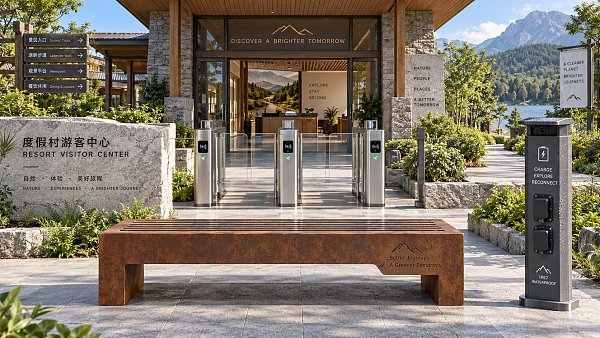
This early exercise prevents a common procurement mistake: buying visually suitable equipment that was designed for a much gentler environment. For example, visitor-center seating must be assessed not only for style but also for cleanability, fire performance, frame stability, and resistance to repeated luggage contact. At a nature resort, exterior lighting and charging hardware may need ingress protection, vandal resistance, and reliable operation in areas where technical support is not immediately available.
Build a specification that separates “must-have” from “nice-to-have”
Specifications often become vague when multiple stakeholders contribute. Designers focus on appearance, operations teams worry about cleaning and replacement, IT teams need compatibility, and finance looks for cost control. All of those concerns are valid, but they must be organized before suppliers submit proposals.
For every line item, divide requirements into three tiers:
- Non-negotiable requirements: safety standards, dimensions, load ratings, required certifications, accessibility provisions, environmental conditions, and system compatibility.
- Scored preferences: finish options, modularity, energy efficiency, delivery lead time, local service capability, and design alignment.
- Optional enhancements: premium finishes, advanced analytics, branded elements, additional automation, or features that can be added later without disrupting operations.
This distinction gives procurement teams a defensible basis for rejecting non-compliant bids while still comparing different commercial approaches. It also avoids the expensive habit of allowing “optional” features to become assumed inclusions during the final negotiation.
Where equipment connects to a building or digital network, request interface details early. Smart locks, room controls, digital signage, ticketing terminals, charging systems, and AI-enabled hotel platforms should not be evaluated as standalone devices. Confirm power requirements, network protocols, API availability, data ownership, cybersecurity controls, user permissions, offline functionality, and future software support. A lower-cost device can become the higher-cost option if it requires a custom integration layer or locks the operator into a proprietary ecosystem.
The procurement checklist: technical evidence to request from suppliers
Marketing brochures can help identify a shortlist, but final evaluation should be evidence-based. The documents requested will vary by category, yet the following checklist applies to most tourism hardware equipment purchases.
1. Material and construction evidence
- Material grades, coatings, finishes, joining methods, and component breakdowns.
- Corrosion, UV, moisture, abrasion, impact, and chemical-resistance information where relevant.
- Load-bearing calculations or test evidence for structures, seating, platforms, railings, play equipment, and elevated installations.
- Details on replaceable components, especially batteries, hinges, cushions, wheels, screens, sensors, locks, and wear surfaces.
- Manufacturing drawings that confirm dimensions, tolerances, fixing points, and installation interfaces.
Ask suppliers to distinguish between standard product construction and project-specific modifications. A custom powder-coat color, altered bracket, or bespoke enclosure may affect the warranty, lead time, or tested performance of the base product.
2. Safety, compliance, and accessibility documentation
- Applicable product safety certifications and test reports.
- Fire, electrical, mechanical, structural, and electromagnetic compliance records where applicable.
- Local building-code and installation considerations, including foundation, anchoring, emergency access, and evacuation requirements.
- Accessibility features relevant to circulation, controls, seating, wayfinding, height ranges, and sensory needs.
- Clear instructions for safe operation, inspection intervals, warning labels, and staff training.
Compliance is not simply a paperwork exercise. Procurement should verify whether a certificate applies to the exact model, configuration, electrical rating, and market in question. A certificate for one component does not necessarily validate the final assembled system. This is particularly important for modular eco-structures, amusement hardware, smart hotel devices, and public-facing charging or payment equipment.
3. Serviceability and operational readiness
Guests do not see spare-parts lists, but they feel the consequences when an amenity is unavailable. Require a preventive-maintenance schedule with estimated labor hours, recommended tools, consumables, and inspection frequency. Ask what parts are stocked regionally, what must be manufactured to order, and whether the supplier can commit to an availability period for critical components.
For high-use equipment, a sensible purchasing decision may include an opening stock of spare parts: replacement sensors, lock cylinders, batteries, fasteners, upholstery panels, control modules, filters, or protective covers. The right list depends on the asset, but it should be agreed before commissioning rather than during the first failure.
Calculate lifecycle cost instead of comparing purchase prices alone
Capital expenditure is visible; operating cost is often scattered across maintenance, utilities, cleaning, staff time, downtime, and replacement purchases. That makes simple price comparison misleading. A procurement scorecard should estimate total cost of ownership over the planned service life of each asset.
Include the following cost elements:
- Product price, freight, insurance, duties, taxes, and currency exposure.
- Site preparation, foundations, electrical works, network installation, assembly, testing, and commissioning.
- Energy and water consumption, where relevant.
- Routine cleaning, inspections, consumables, software subscriptions, and calibration.
- Expected replacement of high-wear components.
- Training requirements and the cost of specialist service calls.
- Downtime risk during peak periods and the operational impact of a failed asset.
- End-of-life removal, recycling, refurbishment, or disposal.
There is no need to pretend every forecast is exact. The value lies in making hidden cost assumptions visible. If one supplier offers a lower initial price but cannot provide replacement parts locally, while another offers modular components and clear maintenance intervals, the apparent gap may narrow quickly.
For digital systems, examine recurring costs with equal care. Licenses, cloud storage, support tiers, cellular connectivity, firmware updates, payment-processing requirements, and cybersecurity monitoring can materially change the five-year cost profile.
Inspect the supplier’s capability, not just the sample
A sample chair, kiosk, cabin panel, or smart device demonstrates design intent. It does not prove that the supplier can produce consistent quality at project scale. Procurement teams should investigate manufacturing controls, quality procedures, capacity, project-management discipline, packaging methods, and export experience.
Useful questions include:
- Which parts are made in-house and which are subcontracted?
- How are incoming materials checked and finished goods inspected?
- Can the supplier provide batch traceability for critical parts?
- What is the realistic production capacity during peak demand?
- How are defects, transit damage, and warranty claims handled?
- Who provides installation supervision and post-handover support?
- Can technical manuals, wiring diagrams, maintenance instructions, and training materials be delivered in the required language?
When the purchase is substantial or safety-sensitive, consider a factory audit, third-party inspection, pilot installation, or pre-shipment review. Independent benchmarking resources such as those developed by TerraVista Metrics can also help buyers compare engineering claims, trade conditions, material performance, and system integration requirements across global supply options.
Do not let sustainability remain a decorative claim
Resorts and visitor centers are increasingly judged by how their infrastructure relates to the landscape and local community. Yet sustainable procurement must be measurable enough to influence the buying decision. Ask about recycled or renewable content, responsible sourcing, repairability, packaging reduction, energy use, emissions-related documentation, and end-of-life pathways.
Durability belongs in this discussion. A product with modest recycled content but a long, repairable service life may be preferable to a lightly built alternative that requires frequent replacement. Likewise, prefabricated tourism structures should be reviewed for thermal performance, ventilation, structural resilience, transport efficiency, and the ability to adapt or relocate rather than be demolished.
Watch for broad claims such as “eco-friendly,” “green material,” or “carbon neutral” without scope or supporting evidence. Procurement does not need to become a sustainability audit department, but it should request clear documentation and state how environmental performance will be weighted in the tender evaluation.
Plan logistics around the destination’s real constraints
Tourism developments are often located where delivery is difficult: island resorts, mountain sites, protected landscapes, dense heritage districts, or properties that cannot close during the season. A product that fits inside a shipping container may still be impossible to move through a narrow access road, lift into a lobby, or install without disrupting guests.
Confirm packaging dimensions, weight, lifting points, container loading plans, unloading equipment, storage needs, and waste removal responsibilities. For modular units and large attraction equipment, review the installation sequence alongside the construction schedule. The procurement team should know which dependencies must be completed before delivery, including foundations, drainage, power, data cabling, permits, and site access.
Delivery terms also deserve close attention. Clarify the transfer of risk, responsibility for import documentation, inspection on arrival, damage-reporting windows, and the commercial treatment of delayed or incomplete shipments. A detailed delivery plan is less glamorous than a product presentation, but it is often what protects the opening date.
Use a weighted decision matrix before negotiating the final price
Once compliant proposals are received, score them against a shared matrix rather than allowing the loudest stakeholder or lowest bid to dominate. Typical criteria may include technical compliance, lifecycle cost, safety evidence, durability, supplier reliability, service support, sustainability, installation complexity, lead time, design suitability, and digital interoperability.
The weighting should change by project. A coastal resort may place more value on corrosion resistance and local maintenance support. A visitor center with high school-group traffic may prioritize safety, cleanability, and accessibility. A smart resort upgrade may give greater weight to data security and integration with existing systems.
Keep written notes for every score. They create an audit trail, help teams explain the decision internally, and reveal where a supplier can improve its offer during clarification. Negotiation is then focused on genuine risk: stronger warranties, spare-parts commitments, better payment milestones, clearer acceptance tests, or training included at handover.
Before signing: the final release checklist
Do not release the purchase order until the commercial document reflects the technical decision. Confirm the exact bill of materials, approved drawings, finish codes, quantities, agreed standards, delivery milestones, inspection rights, acceptance criteria, warranty terms, support contacts, software obligations, and documentation deliverables.
For complex tourism hardware equipment, define what “complete” means. Is installation included? Does commissioning include functional testing under site conditions? Will staff receive operating and maintenance training? Are as-built drawings, passwords, configuration files, and asset registers handed over? Who resolves defects discovered during the first operating season?
A resort or visitor center succeeds when guests can enjoy the destination without noticing the systems behind it. That quiet reliability begins much earlier, at the procurement stage. By asking for verifiable evidence, costing the full operating life, and selecting suppliers that can support the asset after delivery, purchasing teams can protect both the capital plan and the experience visitors came to find.
Recommended News
 Oct 04, 2026A Procurement Checklist for Tourism Hardware Equipment in Resorts and Visitor CentersTourism hardware equipment procurement checklist for resorts and visitor centers: compare durability, compliance, lifecycle costs, supplier support, and logistics.
 Sep 23, 2026Planning Smart Classroom Solutions for Hybrid Learning Without Creating AV Support GapsSmart classroom solutions for reliable hybrid learning: standardize workflows, strengthen AV support, and deliver seamless teaching experiences.
 Sep 11, 2026Hotel Security Protocols: A Compliance Checklist for Protecting Guests and StaffSecurity protocols for hospitality: use this practical hotel compliance checklist to protect guests, staff, data, access points, and emergency operations.
 Sep 03, 2026How to Plan Theme Park Infrastructure for Mixed-Use DevelopmentsTheme park infrastructure for mixed use developments: plan resilient utilities, circulation, attractions, hospitality, and digital systems for scalable destinations.
 Aug 23, 2026What Makes Community Based Eco Resort Development Successful in Rural Destinations?Community based eco resort development succeeds when land fit, local participation, infrastructure, and operations align. Discover practical strategies for resilient, high-value rural eco resorts.
 Aug 21, 2026How Many Rooms Should an Eco Resort Have to Balance ROI and Guest Experience?Eco resort development room count directly shapes ROI, infrastructure efficiency, and guest privacy. Learn how to choose the right key range to protect margins and elevate the experience.
 Aug 15, 2026How to Analyze Stainless Steel Fatigue in Cyclic Load ApplicationsStainless steel fatigue analysis helps you spot hidden cyclic load risks early, improve reliability, and prevent costly failures in real-world applications.
 Aug 08, 2026Hospitality Engineering Standards for Resorts: Key Compliance Checks Before Design ApprovalHospitality engineering standards for resorts explained: discover the key compliance checks before design approval to avoid delays, reduce risk, and build guest-ready, resilient resort projects.
 Jul 21, 2026Tourism Destination Infrastructure Solutions: How to Plan Smarter Visitor FacilitiesTourism destination infrastructure solutions for smarter visitor facilities: learn how to reduce risk, improve uptime, and plan scalable, data-backed destinations that perform long term.
 Jul 19, 2026How to Choose Rustproof Hotel Furniture for Coastal and High-Humidity PropertiesRustproof hotel furniture is essential for coastal and high-humidity properties. Learn how to compare materials, finishes, and supplier claims to reduce maintenance costs and extend service life.
 Jul 16, 2026How to Choose Resort Bar Furniture for Outdoor Hospitality SpacesResort bar furniture buying guide for outdoor hospitality spaces: compare materials, durability, comfort, and maintenance to choose stylish, long-lasting commercial pieces.
 Jul 15, 2026Commercial Thermal Efficiency Testing: Key Metrics, Test Methods, and Compliance BasicsCommercial thermal efficiency testing explained: learn key metrics, test methods, common compliance risks, and practical steps to improve performance, cut costs, and make smarter asset decisions.
 Jul 14, 2026Smart Tourism Integration vs Standalone Systems: Which Setup Fits Multi-Site Operations?Smart tourism integration or standalone systems? Discover which setup best fits multi-site tourism operations, improves visibility, compliance, scalability, and guest experience.
 Jul 13, 2026Export Market Opportunities in Latin America: How to Identify Profitable Entry PointsExport market opportunities in Latin America are shifting toward high-margin, compliant sectors. Discover how to spot profitable entry points in tourism, hospitality, and smart infrastructure.
 Jul 12, 2026Carbon Compliance in North America: Key Reporting Rules and Risk Points for ManufacturersCarbon compliance North America: learn the key U.S. and Canada reporting rules, top risk points for manufacturers, and how to strengthen data, supplier checks, and compliance readiness.
 Jul 11, 2026How to Evaluate Coated Surface Structural Performance Testing for Outdoor InstallationsCoated surface structural performance testing for outdoor installations: learn how to assess adhesion, crack resistance, corrosion durability, and real-world structural risk before procurement.
 Jul 10, 2026Outdoor Furniture Durability Cost: Which Materials Last Longer and Cost Less to Maintain?Outdoor furniture durability cost explained: compare aluminum, teak, steel, and HDPE to find materials that last longer, reduce maintenance, and deliver better long-term value.
 Jul 09, 2026Technical Integration Security: Key Standards, System Architecture, and Risk ChecksTechnical integration security explained: explore key standards, system architecture signals, and risk checks to build resilient, compliant, and scalable connected infrastructure.
 Jul 08, 2026Tourism Asset Evaluation in Middle East: Key Metrics for Hotel and Resort ProjectsTourism asset evaluation in Middle East explained through key metrics for hotel and resort projects, covering location, infrastructure, lifecycle cost, sustainability, and technology.
![]() Jul 07, 2026Eco Building Materials Manufacturer Checklist: Certifications, MOQ, and Custom OptionsEco building materials manufacturer checklist covering certifications, MOQ, and custom options. Learn how to compare suppliers, reduce project risk, and choose sustainable materials with confidence.
 Jul 06, 2026Hospitality Fire Safety Standards Explained: Key Compliance Points for Hotels and ResortsHospitality fire safety standards explained for hotels and resorts: learn key compliance points, risk areas, and practical steps to protect guests, assets, and operations.
 Jul 03, 2026How to Specify High Traffic Furniture Weight Capacity for Hotels, Lobbies, and Public AreasHigh traffic furniture weight capacity for hotels, lobbies, and public areas: learn how to verify load ratings, testing standards, and durability specs to reduce risk and choose smarter.
 Jul 03, 2026Hospitality Procurement Finish Standards Explained: How to Compare Durability, Cost, and ComplianceHospitality procurement finish standards explained: compare durability, lifecycle cost, and compliance with a practical framework for smarter sourcing and fewer costly project delays.
 Jun 30, 2026Tourism Equipment Evaluation Compliance: What to Check Before Purchase and Site DeploymentTourism equipment evaluation compliance: learn what to verify before purchase and site deployment to reduce risk, control costs, ensure safety, and choose suppliers with confidence.
Quarterly Executive Summaries Delivered Directly.
Join 50,000+ industry leaders who receive our proprietary market analysis and policy outlooks before they hit the public library.