Search News
TerraVista Metrics (TVM)Industry Portal
TerraVista Metrics (TVM)Hot Articles
TerraVista Metrics (TVM)- Choosing an Amusement Equipment Testing Agency: Accreditation and ScopeChoosing an amusement equipment testing agency? Learn how to verify accreditation, assess technical scope, and compare reports before you commit.
- Global Temporary Buildings Market Forecast to Reach $5.88 Billion by 2032Global temporary buildings market is forecast to reach $5.88 billion by 2032. Explore the modular, reusable and rapid-assembly trends driving growth.
- Product Benchmarking: How to Compare Material Performance and DurabilityMaster product benchmarking and material comparison with practical tips for evaluating test data, durability and lifecycle costs. Make confident purchasing decisions.
Popular Tags
TerraVista Metrics (TVM)Industry NewsIs an Integrated Hotel System Less Risky Than Separate Systems?
auth.Time
Nov 07, 2026Click Count
An integrated hotel system is less risky when it reduces coordination failures while preserving independent operation of essential services. It becomes more risky when a shared login service, database, network connection, or software update can disable several hotel functions at once. Separate systems offer stronger isolation only when their connections, responsibilities, and recovery procedures are well controlled.
The useful comparison is between two actual architectures: what each depends on, how failures spread, and what remains available during recovery. A single commercial contract does not prove technical integration, and multiple suppliers do not guarantee independence.
Where does integration actually reduce risk?
Integration has its clearest advantage where the same operational fact must move between systems. A room assignment, for example, can affect the property management system (PMS), key issuance, housekeeping status, and room controls. When these systems disagree, a successful transaction in one application can leave the hotel with an incomplete result elsewhere.
Consider a room change after check-in. The reservation record updates, but the access system still recognizes the original room. An integrated workflow can coordinate the change, record whether each step succeeded, and flag an incomplete transfer. Separate applications require interfaces that deliver the same behavior reliably.
The distinction matters because sending a message is different from completing a business action. An interface might confirm that a request arrived without confirming that the new key was issued or the previous credential revoked. Reliable integration records the final outcome and provides a way to resolve partial completion.
Shared data definitions also reduce ambiguity. “Vacant,” “clean,” and “available for sale” describe different conditions. If applications treat them as interchangeable, automation can release a room prematurely. Integration reduces this risk only when the underlying rules are consistent; putting inconsistent rules inside one platform preserves the problem.
Does one platform create a single point of failure?
It can, but the platform label reveals little about the actual failure paths. A suite might contain independently deployed services with separate recovery mechanisms. Several standalone products might all depend on the same internet circuit, identity provider, or integration gateway.
The important measure is the failure radius: how much hotel operation stops when one component fails. A reporting outage should not prevent check-in. A failed room-control gateway should not interrupt payment processing. If these functions share infrastructure, the design needs safeguards that prevent one failure from exhausting resources or spreading into unrelated services.
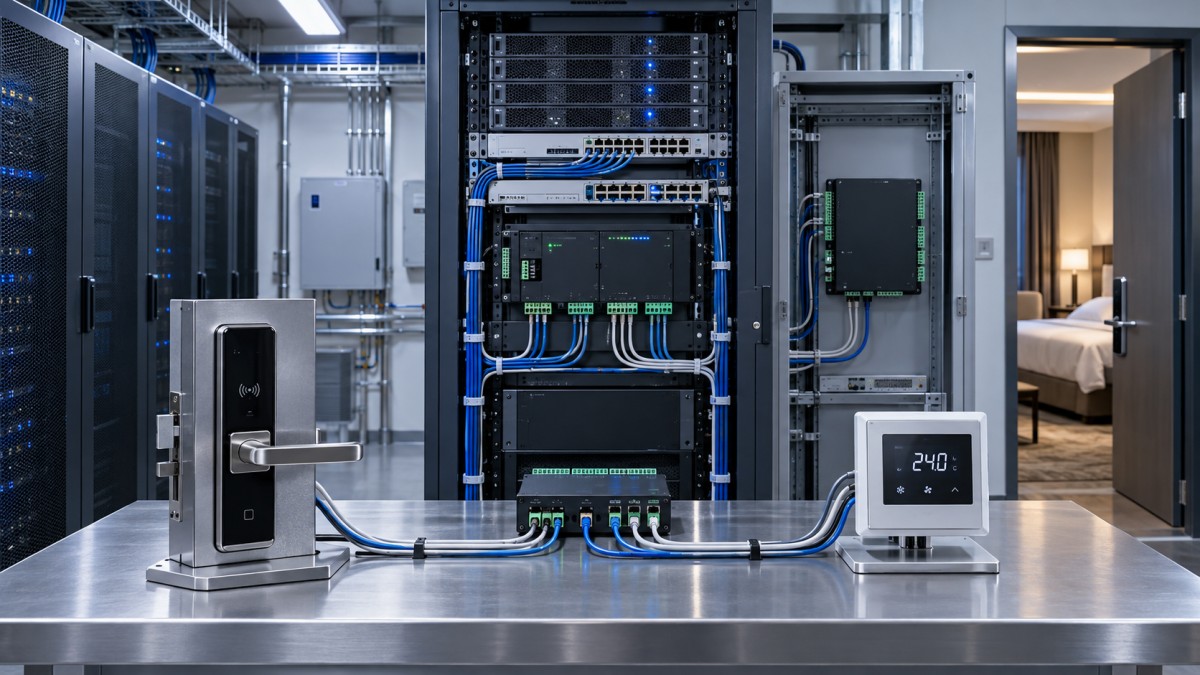
A dependency diagram makes this comparison clearer than a feature list. It should show the applications alongside identity services, databases, gateways, network connections, and local controllers. Shared dependencies often explain why apparently separate systems fail together.

Which functions must survive an outage?
Resilience requires a defined operating state during disruption. “Offline capable” is too broad to establish whether a hotel can continue functioning. Viewing cached reservations, changing a booking, issuing a credential, and processing a payment are separate capabilities with different dependencies.
Door access illustrates the distinction. A lock might continue accepting an existing credential without a cloud connection, while issuing a new credential still requires a central service. That arrangement protects access for checked-in guests but leaves arrivals and room changes exposed. Any fallback needs to address both situations.
Room controls have similar boundaries. Local temperature control can remain available while remote monitoring fails. This is a useful separation if the local controller retains safe settings and responds to physical controls. A device that becomes unusable whenever its management platform disconnects introduces unnecessary operational dependence.
Payment continuity needs its own assessment. Offline acceptance, where supported, involves authorization and settlement constraints; it cannot be assumed from general platform availability. A fallback process must preserve transaction records and prevent a manually recorded charge from being collected again after recovery.
Recovery objectives should therefore be defined by function. Recovery time describes how long a service can remain unavailable. Recovery point describes how much recent data loss is tolerable. A restored database does not establish that room assignments, credentials, and financial records have returned to a consistent state.
Is an integrated system more secure?
Integration can simplify security administration by centralizing account removal, access reviews, and event logging. When a staff account is disabled, connected applications should stop accepting its access without separate manual action. That benefit depends on whether individual applications actually enforce the central decision and invalidate existing sessions appropriately.
Centralization also creates a valuable attack target. A privileged account with access across reservations, room devices, and financial functions gives an intruder a wide reach. Multifactor authentication improves account protection, but permissions still need to match specific duties, and routine accounts should not inherit broad administrative access.
Connected room devices deserve particular attention. Guest Wi-Fi, building controls, door-access infrastructure, and business applications need deliberate network boundaries. Communication across those boundaries should be limited to required services. A device should not gain broad access to guest records merely because both belong to an integrated environment.
Separate systems introduce a different security burden: more accounts, interface credentials, remote-support channels, and patch schedules. Long-lived integration credentials are especially problematic when nobody owns their rotation or removal. Security improves when every connection has a defined purpose, limited permissions, and an accountable maintenance owner.
When are separate systems the safer choice?
Separate systems have an advantage when a function requires a distinct maintenance cycle or must continue independently of the wider hotel platform. Door access and building controls, for example, can justify local autonomy because their physical operating requirements differ from those of reservation or reporting software.
Specialized applications also reduce replacement risk when one capability needs to change without disrupting the rest of the property. That advantage disappears if the application relies on undocumented interfaces or if replacing it requires rebuilding every surrounding workflow.
A mixed architecture can retain a shared operational record while allowing access control and room devices to operate locally. The interfaces then carry defined updates rather than making every local action depend on the central platform. This arrangement requires clear rules about which system owns each piece of information.
For example, reservation data might establish the authorized occupancy period, while the access system manages credential status. During a connection failure, the design must specify whether new credentials are permitted, how changes are recorded, and which record takes precedence after reconnection. Without those rules, independence creates conflicting records.
What evidence makes a comparison credible?
A normal demonstration establishes that a workflow works under favorable conditions. Risk assessment needs evidence from interrupted workflows. Useful tests introduce a fault at a meaningful point and observe the operational outcome:
- Disconnect the property from the hosted service during an arrival workflow. Establish which steps remain available and whether the partial transaction is visible after reconnection.
- Replay a previously delivered room-charge message. The receiving system should recognize the duplicate rather than create another charge.
- Delay a room-status update until a newer update has arrived, then observe whether the older event incorrectly overwrites the current state.
- Disable a shared dependency, such as authentication or an integration gateway, and record which otherwise healthy functions become inaccessible.
- A backup restoration should include reconciliation across connected systems. Restoring files alone does not demonstrate operational recovery.
Test conditions matter. A demonstration with a few devices does not establish performance during simultaneous arrivals, housekeeping updates, and room-control traffic. Throughput figures need context: message size, concurrent activity, response time, and behavior when queues build up.
Likewise, an uptime figure can conceal different operational outcomes. A platform might remain technically available while an essential interface has stopped processing updates. Availability evidence should identify the service measured, the measurement point, and whether failed transactions count as downtime.
Can upgrades and vendor dependence change the answer?
Yes. An architecture that performs reliably today can become difficult to maintain if every upgrade requires coordinated changes across the property. Integrated suites reduce some compatibility work, but a broad release can also introduce simultaneous defects. Separate systems permit independent upgrades only when interfaces tolerate version differences.
Release controls should include a representative test environment, staged deployment where feasible, and a documented rollback path. Rolling back application code is insufficient if the release has also changed stored data in a way the previous version cannot read.
Vendor dependence is measurable through exit requirements. Useful exports preserve relationships between reservations, folios, rooms, and relevant audit records. A spreadsheet of isolated fields can leave essential context behind. Export access, interface documentation, retention arrangements, and assistance with transition all affect the effort required to replace a system.
Contractual accountability also matters during cross-system failures. With separate suppliers, an unresolved incident can move between support desks unless responsibility for diagnosis is assigned. A single supplier simplifies escalation only if its support commitment covers the complete workflow, including components supplied by third parties.
Lifecycle cost belongs in the comparison where it affects sustained reliability. Interface maintenance, local fallback equipment, recovery exercises, and upgrade testing require continuing resources. A low initial price offers little protection if essential maintenance cannot be funded.
What should determine the final choice?
The strongest choice is the architecture that demonstrates fewer workflow errors, a contained failure radius, and reliable recovery under the property's actual operating conditions. Integration earns its advantage through consistent data and coordinated transactions. Separation earns its advantage through tested isolation and independent operation.
Before acceptance, define observable outcomes for interrupted arrivals, room changes, credential issuance, and financial reconciliation. Record what continues, what stops, what data is retained, and how normal operation resumes. A claim of lower risk becomes credible when those outcomes can be reproduced.
Recommended News
 Oct 30, 2026Choosing Woven Rope Resort Furniture for Sun and Salt ExposureChoosing woven rope resort furniture? Discover how to assess UV resistance, coastal corrosion, and supplier evidence for lasting comfort and value.
 Oct 26, 2026Is an Integrated Hotel System Less Risky Than Separate Systems?Is one integrated hotel system less risky than separate systems? Compare outage resilience, security, and recovery to discover the safer architecture for your hotel.
 Oct 18, 2026Can Hotel Room Accessibility Be Improved Without a Full Renovation?Can hotel rooms be made more accessible without a full renovation? Discover practical upgrades to layouts, controls, and bathrooms—and learn when bigger changes are needed.
 Oct 16, 2026How Can You Fix Scratched Luxury Furniture Without Replacing It?How can I repair scratched luxury furniture finishes without replacing the furniture? Discover finish-safe touch-ups, color matching, and expert repair tips to restore elegance and protect value.
 Oct 04, 2026A Procurement Checklist for Tourism Hardware Equipment in Resorts and Visitor CentersTourism hardware equipment procurement checklist for resorts and visitor centers: compare durability, compliance, lifecycle costs, supplier support, and logistics.
 Sep 23, 2026Planning Smart Classroom Solutions for Hybrid Learning Without Creating AV Support GapsSmart classroom solutions for reliable hybrid learning: standardize workflows, strengthen AV support, and deliver seamless teaching experiences.
 Sep 11, 2026Hotel Security Protocols: A Compliance Checklist for Protecting Guests and StaffSecurity protocols for hospitality: use this practical hotel compliance checklist to protect guests, staff, data, access points, and emergency operations.
 Sep 03, 2026How to Plan Theme Park Infrastructure for Mixed-Use DevelopmentsTheme park infrastructure for mixed use developments: plan resilient utilities, circulation, attractions, hospitality, and digital systems for scalable destinations.
 Aug 23, 2026What Makes Community Based Eco Resort Development Successful in Rural Destinations?Community based eco resort development succeeds when land fit, local participation, infrastructure, and operations align. Discover practical strategies for resilient, high-value rural eco resorts.
 Aug 21, 2026How Many Rooms Should an Eco Resort Have to Balance ROI and Guest Experience?Eco resort development room count directly shapes ROI, infrastructure efficiency, and guest privacy. Learn how to choose the right key range to protect margins and elevate the experience.
 Aug 15, 2026How to Analyze Stainless Steel Fatigue in Cyclic Load ApplicationsStainless steel fatigue analysis helps you spot hidden cyclic load risks early, improve reliability, and prevent costly failures in real-world applications.
 Aug 08, 2026Hospitality Engineering Standards for Resorts: Key Compliance Checks Before Design ApprovalHospitality engineering standards for resorts explained: discover the key compliance checks before design approval to avoid delays, reduce risk, and build guest-ready, resilient resort projects.
 Jul 21, 2026Tourism Destination Infrastructure Solutions: How to Plan Smarter Visitor FacilitiesTourism destination infrastructure solutions for smarter visitor facilities: learn how to reduce risk, improve uptime, and plan scalable, data-backed destinations that perform long term.
 Jul 19, 2026How to Choose Rustproof Hotel Furniture for Coastal and High-Humidity PropertiesRustproof hotel furniture is essential for coastal and high-humidity properties. Learn how to compare materials, finishes, and supplier claims to reduce maintenance costs and extend service life.
 Jul 16, 2026How to Choose Resort Bar Furniture for Outdoor Hospitality SpacesResort bar furniture buying guide for outdoor hospitality spaces: compare materials, durability, comfort, and maintenance to choose stylish, long-lasting commercial pieces.
 Jul 15, 2026Commercial Thermal Efficiency Testing: Key Metrics, Test Methods, and Compliance BasicsCommercial thermal efficiency testing explained: learn key metrics, test methods, common compliance risks, and practical steps to improve performance, cut costs, and make smarter asset decisions.
 Jul 14, 2026Smart Tourism Integration vs Standalone Systems: Which Setup Fits Multi-Site Operations?Smart tourism integration or standalone systems? Discover which setup best fits multi-site tourism operations, improves visibility, compliance, scalability, and guest experience.
 Jul 13, 2026Export Market Opportunities in Latin America: How to Identify Profitable Entry PointsExport market opportunities in Latin America are shifting toward high-margin, compliant sectors. Discover how to spot profitable entry points in tourism, hospitality, and smart infrastructure.
 Jul 12, 2026Carbon Compliance in North America: Key Reporting Rules and Risk Points for ManufacturersCarbon compliance North America: learn the key U.S. and Canada reporting rules, top risk points for manufacturers, and how to strengthen data, supplier checks, and compliance readiness.
 Jul 11, 2026How to Evaluate Coated Surface Structural Performance Testing for Outdoor InstallationsCoated surface structural performance testing for outdoor installations: learn how to assess adhesion, crack resistance, corrosion durability, and real-world structural risk before procurement.
 Jul 10, 2026Outdoor Furniture Durability Cost: Which Materials Last Longer and Cost Less to Maintain?Outdoor furniture durability cost explained: compare aluminum, teak, steel, and HDPE to find materials that last longer, reduce maintenance, and deliver better long-term value.
 Jul 09, 2026Technical Integration Security: Key Standards, System Architecture, and Risk ChecksTechnical integration security explained: explore key standards, system architecture signals, and risk checks to build resilient, compliant, and scalable connected infrastructure.
 Jul 08, 2026Tourism Asset Evaluation in Middle East: Key Metrics for Hotel and Resort ProjectsTourism asset evaluation in Middle East explained through key metrics for hotel and resort projects, covering location, infrastructure, lifecycle cost, sustainability, and technology.
![]() Jul 07, 2026Eco Building Materials Manufacturer Checklist: Certifications, MOQ, and Custom OptionsEco building materials manufacturer checklist covering certifications, MOQ, and custom options. Learn how to compare suppliers, reduce project risk, and choose sustainable materials with confidence.
{item.publish_time}{item.title}{item.description}Quarterly Executive Summaries Delivered Directly.
Join 50,000+ industry leaders who receive our proprietary market analysis and policy outlooks before they hit the public library.