Search News
TerraVista Metrics (TVM)Industry Portal
TerraVista Metrics (TVM)Hot Articles
TerraVista Metrics (TVM)- Choosing an Amusement Equipment Testing Agency: Accreditation and ScopeChoosing an amusement equipment testing agency? Learn how to verify accreditation, assess technical scope, and compare reports before you commit.
- Global Temporary Buildings Market Forecast to Reach $5.88 Billion by 2032Global temporary buildings market is forecast to reach $5.88 billion by 2032. Explore the modular, reusable and rapid-assembly trends driving growth.
- Product Benchmarking: How to Compare Material Performance and DurabilityMaster product benchmarking and material comparison with practical tips for evaluating test data, durability and lifecycle costs. Make confident purchasing decisions.
Popular Tags
TerraVista Metrics (TVM)Industry NewsHow Do I Check Smart Lock Compatibility With Existing Hotel Software?
auth.Lydia Vancini (Smart Hospitality IoT Consultant)Time
Nov 07, 2026Click Count
Smart locks are compatible with existing hotel software only when the complete access workflow works—not merely when the lock supplier lists your property management system (PMS) as a supported partner. You need to verify the exact software versions, integration route, credential functions, and behavior during changes or outages. A connection that issues a key at check-in may still fail to revoke it after an early departure or update it during a room move.
The strongest evidence is a documented integration for your configuration, backed by a pilot using the intended hardware and representative hotel workflows. Before committing to a rollout, ask both software and lock suppliers to confirm what is supported, who maintains the connection, and which functions depend on internet access, gateways, or manual intervention.
What information should I collect before asking whether the locks are compatible?
Start with a precise inventory of the systems involved. A PMS product name alone is insufficient because compatibility can differ between cloud and on-premises deployments, software releases, interface packages, and regional editions.
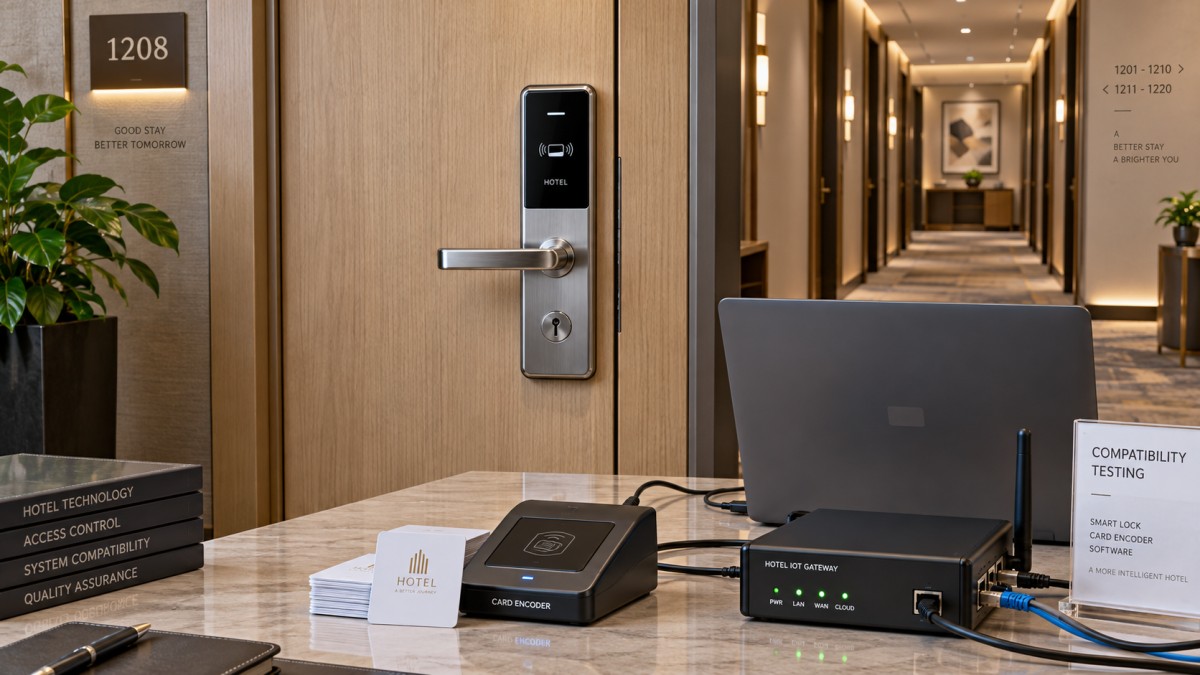
Record your PMS edition and version, hosting arrangement, enabled integration modules, and any planned upgrade. Add the existing lock-management platform, card encoders, guest app, mobile check-in service, and systems controlling shared entrances, elevators, or parking. For proposed locks, identify the model, firmware, credential technology, and required gateways or controllers.
Describe the workflows you intend to preserve or introduce. Front-desk card issuance, mobile keys, self-service check-in, and automatic checkout revocation are separate requirements. Support for one does not establish support for the others.
A useful vendor inquiry is specific: “Can this lock model and management-software release work with our PMS deployment to issue room cards, deliver mobile credentials, process room changes, and restrict access to shared areas?” That question produces more actionable evidence than “Does it integrate with our PMS?”
Does the smart lock connect directly to the PMS?
Not necessarily. The PMS manages reservations, room assignments, and stay status. A lock-management platform translates those records into access permissions and credentials. Middleware or a guest-service platform may sit between them.
A typical path is: PMS event → integration connector → lock-management platform → card encoder or mobile-key service → credential → door. Networked locks may also receive commands through a gateway. Offline locks can validate credentials locally without receiving every reservation update.

Ask suppliers to diagram the actual architecture for your property, including where data travels and which component owns each action. A diagram should distinguish issuing a credential from transmitting an update to a door; these are not interchangeable.
This distinction explains why a hotel can issue cards from its front desk without being able to cancel a lost card immediately at every door. The connection to the PMS may work correctly while the door-side architecture imposes a revocation limit.
Also establish whether the integration uses an API, a local service, a vendor-specific interface, or file exchange. Each route has different installation requirements, failure modes, and support responsibilities.
What evidence should I request from the suppliers?
A compatibility logo or partnership announcement is a starting point, not acceptance evidence. Request written confirmation from both sides that the proposed configuration is supported in production.
Distinguish an existing supported connector from a proposed custom development. “Our API allows integration” means a connection may be technically possible; it does not prove that reservation events, access rules, retries, and error recovery have already been implemented.
For custom work, require an agreed scope, acceptance tests, maintenance arrangements, and access to operational documentation. Otherwise, the hotel risks becoming responsible for an integration that neither supplier treats as part of its supported product.
Which hotel workflows must the integration support?
Check the reservation lifecycle, not just a successful check-in. The important question is whether each change produces the intended access rights at the correct time.
- Check-in: Credentials activate only after the required hotel approvals and room assignment.
- Stay extension: The expiry changes correctly, with any required card rewrite or mobile refresh clearly identified.
- Early departure: Access ends according to the hotel’s policy and the system’s actual revocation capability.
- Room move: The guest gains access to the new room, while access to the previous room is removed through a defined process.
- Lost credential: Replacement issuance handles the missing credential without unintentionally cancelling valid companions’ keys.
- Shared facilities: Access to entrances, elevators, lounges, and parking matches the guest’s entitlement.
- Multiple occupants: Separate credentials and different arrival or departure times behave as required.
Confirm which system is authoritative for room assignment, stay dates, and access entitlements. If staff can change access independently in the lock platform, determine whether those changes persist, return to the PMS, or are overwritten by the next synchronization.
Room identifiers also need explicit mapping. A displayed room number is not necessarily the unique identifier used internally by each system. Incorrect mapping can produce valid credentials for the wrong door, making this a safety issue rather than a minor data-quality problem.
How do I verify mobile-key compatibility?
Mobile-key compatibility has additional layers beyond PMS integration. The phone must receive an authorized credential, the app or wallet must support its delivery, and the lock must recognize the credential technology.
Bluetooth or NFC support alone does not establish interoperability. Two products can use the same radio technology while relying on different credential formats, cryptographic keys, provisioning services, or software development kits.
Ask whether guests need the lock supplier’s app, your existing hotel app, or a supported digital wallet. Confirm supported phone operating systems, device requirements, and what happens when a guest changes phones or reinstalls the app.
Separate credential delivery from door opening during testing. A phone might need connectivity to receive or refresh a key but not to unlock a door afterward. Conversely, some implementations depend on an online authorization step. The supplier should explain the behavior of the proposed configuration rather than make a general claim about mobile access.
Keep a defined alternative for guests without a compatible phone or with a depleted battery. Mobile access should not make ordinary check-in dependent on a guest’s device meeting an undisclosed technical requirement.
What happens if the internet, PMS, or gateway goes offline?
Compatibility includes predictable failure behavior. Test internet loss, PMS unavailability, gateway failure, and lock-platform disruption separately because they affect different parts of the access chain.
Determine whether existing credentials continue working, whether staff can issue new ones, and whether cancellations or room moves reach the doors. Local credential validation can preserve guest entry during an outage, but it does not necessarily preserve immediate revocation.
A successful cancellation in the PMS is not proof that the door has rejected the credential. On an offline lock, invalidation may require a replacement credential to be presented, a local update, another vendor-defined mechanism, or the original credential to expire. The applicable method must be documented and tested.
After connectivity returns, check how queued events are reconciled. An old stay-extension message must not override a later checkout. Ask how the connector handles duplicate events, missed notifications, and events arriving out of order. Repeated delivery should not create unintended additional credentials.
Define the fallback procedure before deployment: authorized staff actions, temporary credential issuance, escalation, and reconciliation after recovery. A workaround that silently grants excessive access is not an acceptable resilience strategy.
Which security and data-protection checks affect compatibility?
An integration may be functional yet unacceptable under the hotel’s security requirements. Establish what information leaves the PMS, why it is needed, where it is stored, and which suppliers or subcontractors can access it.
The lock platform may need a reservation reference, room assignment, and validity period without needing the guest’s full profile. Require a field-level explanation rather than assuming every available PMS field should be shared.
Check authentication, encryption in transit, service-account permissions, administrator access controls, and credential-secret management. Integration accounts should have only the permissions required for their functions. Administrative access should use multifactor authentication where supported.
Audit records should distinguish permission creation, credential issuance, update delivery, and door activity where the hardware records it. A log showing that a key was generated does not prove that the door received a revocation command.
Review applicable privacy obligations for guest data and access histories, particularly when services operate across borders. Security certifications can support supplier assessment, but their scope must cover the relevant service; they do not independently prove PMS compatibility or correct access behavior.
How should I run a compatibility pilot?
Use a limited deployment with the intended lock model, firmware, gateways, encoders, and software configuration. A showroom demonstration proves little about your property’s room mapping, network conditions, or reservation workflows.
Create test reservations that cover normal stays and exceptions. Include a room move, early checkout, extension, duplicate event, lost key, shared-area permission, and overlapping occupants. Use designated test rooms or a controlled test environment so credential checks do not affect occupied rooms.
For each scenario, record the initiating action, expected permissions, actual result at the door, elapsed time, and any manual work. Test old credentials as well as new ones. A replacement key opening the correct room does not prove that the previous key stopped working.
Set acceptance criteria before testing. Specify permitted update delays, required fallback functions, and unacceptable outcomes, such as access to an unassigned room. Include representative peak transaction load and interruption-and-recovery tests.
Preserve logs from the PMS, connector, and lock platform with synchronized timestamps. This helps distinguish a missing PMS event from connector failure or a door-side delivery problem. Record the tested version combination so later upgrades can trigger appropriate regression checks.
When is there enough evidence to approve the rollout?
Approval is justified when the exact configuration is supported, required workflows pass at the door, outage limitations are understood, and operational ownership is agreed. An unresolved access-control failure should block rollout even if routine key issuance succeeds.
Put the validated configuration and acceptance criteria into the purchase or implementation agreement. Include responsibility for connector maintenance, software upgrades, incident escalation, and retesting after material changes.
Price the complete working system: interface licenses, middleware, mobile-key services, gateways, encoders, installation, support, and any custom maintenance. A lower lock price can be misleading if essential integration components are excluded.
The decisive test is whether a change in hotel software produces the intended change in door access—with known timing, traceable evidence, and a safe fallback when a component fails. That is the difference between a claimed integration and compatibility the hotel can rely on.
Recommended News
 Oct 26, 2026Roseate Targets 30 Hotels by 2030, Plans New Smart Hotel BrandRoseate Hotels & Resorts targets 30 hotels by 2030, with an upscale smart hotel brand planned for early 2027. Explore its expansion strategy across India's smaller cities and core markets.
 Oct 20, 2026Amadeus Adds Embedded Travel Protection to iHotelierAmadeus adds embedded travel protection to iHotelier with Pattern. Explore the potential for greater guest confidence, new hotel revenue and key considerations before adoption.
 Oct 17, 2026Custom Smart Hotel Solutions: Integrating Room Controls With Your Existing PMSDiscover a smart hotel custom solution that connects room controls to your existing PMS, enhances guest comfort, and improves reliability without unnecessary infrastructure replacement.
 Oct 26, 2026Why Did Hotel Room Controls Stop Syncing After a Software Update?Why did hotel room controls stop syncing after a software update? Discover common causes, practical fixes, and testing steps to restore reliable lighting, temperature, and occupancy control.
 Oct 25, 2026How Do I Check Smart Lock Compatibility With Existing Hotel Software?How do I check whether smart locks will work with our existing hotel software? Discover PMS checks, mobile-key tests, and outage safeguards to validate compatibility before you invest.
 Oct 22, 2026Where to Place Smart Sensors in Hotels for Early Water Leak DetectionDiscover where to place smart sensors for hospitality properties to detect water leaks early. Protect guestrooms, HVAC units, and service areas with practical placement tips.
 Oct 22, 2026How Smart Sensors Connect to Hotel Property and Building Management SystemsExplore smart sensors for hospitality property management: learn how PMS and BMS integration supports guest comfort, reliable controls, and security—and what to verify before deployment.
 Oct 19, 2026How Can You Verify Energy Cost Savings From Hotel Room Automation?How do I check whether room automation actually reduced energy costs? Learn to verify hotel savings with occupancy-adjusted data, tariff analysis, and comfort checks before investing.
 Oct 17, 2026How Do You Revoke a Former Contractor's Access to Hotel Smart Systems?How do I revoke a former contractor's access to hotel smart systems? Get a practical checklist to disable accounts, revoke keys, and secure integrations without disrupting hotel operations.
 Sep 25, 2026Resort System Integration: How to Connect PMS, Guestroom Controls, and KiosksResort system integration guide: connect PMS, guestroom controls, and kiosks with reliable workflows, secure data, and seamless guest experiences.
 Sep 08, 2026How to Build Stable Interoperability Across Hotel Guestroom SystemsHospitality system interoperability stable: learn how hotels can align room states, command priorities, local fallback, and testing for reliable guestroom operations.
 Aug 18, 2026What Hotel System Interoperability Means for PMS, POS, and Guestroom TechHotel system interoperability shapes how PMS, POS, and guestroom tech perform in real hotels. Learn the key risks, validation points, and smarter ways to build resilient operations.
 Aug 10, 2026How to Evaluate a Smart Hotel System Integration Quotation Before ApprovalSystem integration quotation for smart hotels: learn how to assess scope, interoperability, cybersecurity, lifecycle cost, and hidden risks before approval.
 Jul 28, 2026How to Evaluate a Smart Hotel Application for Guest Experience and Staff EfficiencySmart hotel application evaluation made practical: learn how to compare integrations, guest journey design, staff workflows, security, and total cost to choose a smarter hotel solution.
 Jul 12, 2026Premium Camping Q2 Up 19% as Europe Expands Guestroom AutomationPremium camping grew 19% in Q2 as Europe accelerates guestroom automation. Discover how Germany, France, and Switzerland are driving demand for smarter campsites.
 Jul 11, 2026System Integration Testing for Resorts: Key Steps Before Guestroom Tech Goes LiveSystem integration testing for resorts: discover the 6 essential pre-opening steps to prevent guestroom tech failures, reduce launch risk, and protect guest satisfaction.
 Jul 10, 2026Hospitality System Interoperability Buyer Guide: What to Check Before You BuyHospitality system interoperability buyer guide: learn what to verify before you buy, from APIs and device compatibility to security, scalability, hidden costs, and vendor risk.
 Jul 09, 2026CPSC advisory puts offline AI checks on hotel voice devicesCPSC advisory reshapes compliance for hotel voice devices with offline AI. Learn how FCC Part 15 checks, labeling, and shipment readiness may impact U.S. hotel projects.
 Jul 08, 2026CPSC Sets Offline AI Rule for Guestroom Voice ModulesCPSC Sets Offline AI Rule for Guestroom Voice Modules: learn how the 2026 U.S. update impacts compliance, imports, hotel tech sourcing, and recall risk for suppliers.
 Jul 07, 2026CPSC Sets Offline AI Bar for Hotel Voice DevicesCPSC sets a new offline AI bar for hotel voice devices. Learn how the 2026 guidance impacts guestroom automation, import checks, supplier compliance, and hotel procurement decisions.
![]() Jul 06, 2026CPSC Requires Offline AI in Guestroom Voice SystemsCPSC requires offline AI in guestroom voice systems starting Oct 1, 2026. Learn how this rule impacts Alexa/Google integrations, compliance, procurement, and U.S. market shipments.
 Jul 06, 2026How to Reduce Hospitality System Interoperability Latency Across PMS, POS, and IoTHospitality system interoperability latency affects guest experience, revenue accuracy, and IoT responsiveness. Learn practical ways to reduce delays across PMS, POS, and smart hotel systems.
 Jul 05, 2026CPSC Orders Offline AI for Hotel Voice ModulesCPSC orders offline AI for hotel voice modules by Oct 1, 2026. Learn how local AI inference rules will impact U.S. hotel automation sourcing, integration, and compliance.
 Jul 04, 2026CPSC Mandates Offline AI for Guestroom Voice UnitsCPSC mandates offline AI for guestroom voice units entering the U.S. Learn how FCC Part 15B and UL 60730-1 compliance will reshape hotel procurement, OEM design, and delivery plans.
{item.publish_time}{item.title}{item.description}Quarterly Executive Summaries Delivered Directly.
Join 50,000+ industry leaders who receive our proprietary market analysis and policy outlooks before they hit the public library.