Search News
TerraVista Metrics (TVM)Industry Portal
TerraVista Metrics (TVM)Hot Articles
TerraVista Metrics (TVM)- How to Evaluate Spark Plug Suppliers for Consistent Quality and Lead TimesSpark plugs supplier evaluation guide: compare quality control, traceability, fitment, total cost, and reliable lead times to secure dependable engine maintenance supply.
- What Drives System Interoperability Testing Service Costs in Complex Projects?System interoperability testing service cost depends on integration scope, workflows, environments, and assurance needs. Learn how to budget smarter and reduce project risk.
- Project Planning Sourcing Guides: How to Qualify Suppliers Before Work StartsSourcing guides project planning helps teams qualify suppliers before work begins—verify compliance, delivery capacity, financial strength, and sustainability to reduce risk and protect project outcomes.
Popular Tags
TerraVista Metrics (TVM)Industry NewsHow to Build Stable Interoperability Across Hotel Guestroom Systems
auth.Lydia Vancini (Smart Hospitality IoT Consultant)Time
Oct 07, 2026Click Count
Stable interoperability begins with a clear engineering rule: every guestroom function must retain a defined, safe behavior when another system is slow, unavailable, upgraded, or delivering invalid data. A room is not interoperable merely because a mobile application can switch on a lamp or because a dashboard displays device status. It is interoperable when lighting, HVAC, access control, occupancy sensing, bedside controls, television, service platforms, and property data exchange information through documented interfaces without creating conflicting commands or unsafe fallback states.
The most common failure is a room that works during a staged demonstration but becomes unpredictable after commissioning. A door unlock event may not update room occupancy. An energy-management controller may interpret a stale occupancy flag as a vacancy and set back conditioning while the guest is present. A tablet may show an incorrect temperature because it is reading a cloud cache rather than the local controller. These are not isolated device defects. They are failures in data ownership, timing, state handling, or interface design.
Define the Room as a Set of Authoritative States
Before selecting protocols or gateway hardware, define the states that the room must represent and identify the authoritative source for each one. Typical states include reservation status, checked-in status, access granted, door position, privacy request, occupancy, balcony contact, maintenance lockout, HVAC mode, lighting scene, alarm state, and network health. Each state needs an owner, an update path, a permitted set of values, and a behavior when the source cannot be reached.
“Occupied” deserves particular care because several signals can appear to describe the same condition while serving different purposes. A property platform may mark a room occupied after check-in. A door lock may record an entry event. A motion sensor can indicate recent movement. A connected thermostat may infer presence from user interaction. None of these is a universal substitute for the others. Check-in is a commercial status, door entry is an access event, and motion is a local physical observation. Combining them without a decision model produces contradictory automation.
For example, an occupied room should not necessarily mean continuous motion, and a room with no detected movement should not immediately be treated as vacant. Sleeping guests, accessible rooms, long bathroom stays, and guests reading without movement all challenge aggressive occupancy logic. A reliable design separates the guest lifecycle state from local presence evidence. The first may govern access entitlement and service workflow; the second may influence lighting timeout or HVAC setback only after a deliberate delay and with room-specific exceptions.
State Ownership Prevents Command Collisions
Each function needs a clear control boundary. The local lighting controller should remain authoritative for load operation, dimming limits, scene execution, and manual switch input. A guest application, wall panel, voice interface, or central service system should request a scene or setting through that controller rather than directly writing to individual relays. This reduces the number of systems that can leave loads in inconsistent states.
The same principle applies to HVAC. The room controller should enforce equipment protection, fan delays, condensate safeguards, temperature limits, and local sensor validity. Higher-level systems can provide setpoints, eco-mode requests, or reservation-based preconditioning schedules. They should not bypass the local control sequence. Direct cloud commands to field devices often appear simpler at installation, yet they create obscure dependencies when internet connectivity changes or device firmware evolves.
Choose Interfaces by Function, Not by Marketing Labels
“Open protocol” is not enough to establish hospitality system interoperability. A protocol may define transport and message syntax while leaving device semantics, event ordering, fault reporting, and commissioning behavior inconsistent across implementations. Two devices can exchange packets successfully while interpreting the same command differently.
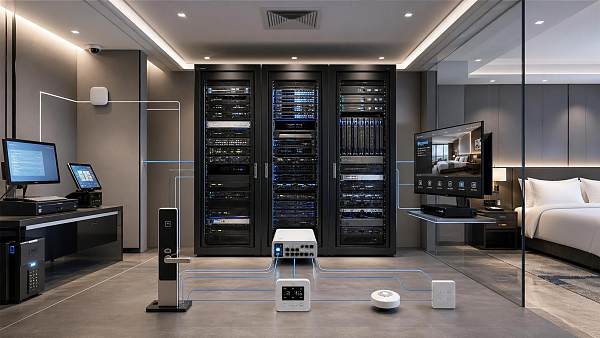
Assessment should distinguish four layers:
- Physical and network layer: wiring topology, radio coverage, address allocation, power resilience, VLAN segmentation, and the practical reach of gateways across floors and risers.
- Transport layer: how systems connect, authenticate, reconnect, encrypt traffic, and behave after an interrupted session.
- Information model: object names, units, enumerations, timestamps, quality flags, alarm priorities, and whether a command represents a target value or a confirmed device state.
- Operational contract: commissioning ownership, firmware compatibility, change approval, logging, fault escalation, and the procedure for replacing a failed controller.
A gateway can translate one protocol into another, but translation does not automatically preserve meaning. A simple binary “do not disturb” signal is relatively easy to map. A multi-state door-lock event sequence, with audit records, temporary credential status, emergency opening rules, battery condition, and privacy latch logic, is more complex. Lossy mapping can make an interface appear complete until an exceptional condition occurs.
Require an interface register rather than accepting a generic statement of compatibility. The register should identify every exchanged point, its data type, unit, valid range, read or write permissions, update method, expected latency, retention behavior, alarm condition, and owning system. It should also indicate whether the value is event-driven, periodically polled, manually updated, or calculated. This document exposes missing semantics early, particularly where one supplier uses a status point as though it were a command acknowledgment.
Local Continuity Must Survive Cloud and Platform Outages
Guestroom comfort and essential access functions should not depend on continuous external connectivity. A property platform outage must not disable credential validation already issued to a lock, erase wall-control operation, or force HVAC equipment into an undefined state. Cloud services are useful for analytics, remote configuration, orchestration, and cross-property visibility, but basic room behavior requires a local operating mode.
For each integration, specify a degraded-mode matrix. If the property-management connection fails, determine whether existing room credentials continue, whether new credentials can be issued locally, and how staff access is handled. If an occupancy service becomes unavailable, define whether the HVAC controller retains the last valid mode, enters a conservative schedule, or uses its local sensors. If a gateway is offline, identify which functions remain peer-to-peer and which lose supervisory automation.
Degraded mode is not a single “offline” setting. A local network failure, loss of an upstream application, expired credentials, unavailable name resolution, and partial gateway failure have different effects. Testing only by unplugging an internet connection misses cases in which the network remains live but a service returns delayed, malformed, or unauthorized responses.
Design Command Priority Explicitly
Guestroom systems receive commands from sources with different authority: manual wall controls, room panels, service applications, automation schedules, access events, emergency logic, maintenance tools, and central supervisory systems. Without an explicit priority model, the last message received often wins. That behavior is unsuitable where a manual guest action should temporarily override an energy-saving rule, or where an alarm condition must supersede a comfort request.
Priority must include duration and release conditions. Consider a guest selecting a warmer setpoint shortly after entry. The room controller may honor that choice until checkout, until a defined inactive period, or until a central safety constraint applies. These alternatives have different guest-experience and energy consequences. The requirement should state which one applies, rather than leaving it to individual device defaults.
Manual controls should continue to function during integration faults. A wall switch that only sends an event to a central server before operating the light introduces an unnecessary point of failure. Similarly, a bedside panel should display a true device state when possible, not merely the last command it transmitted. Command acknowledgment, state confirmation, and user-interface feedback are separate events. Treating them as identical is a frequent source of misleading displays.
Time, Identity, and Data Quality Are Integration Infrastructure
Many hard-to-trace room issues are timestamp problems. Door events, privacy requests, occupancy transitions, and maintenance actions need a common time basis for auditability and sequence analysis. Devices should synchronize time through an approved source, retain reasonable behavior during loss of synchronization, and report when their clocks are unreliable. A controller that reports an event with an incorrect clock can cause an investigation to focus on the wrong sequence of actions.
Identity must also be consistent across systems. The room number displayed to a guest, the property platform room identifier, network location, controller address, lock identifier, and maintenance asset tag are often different. A controlled mapping is necessary. Hard-coding room numbers inside several systems creates retrofit risk when room inventory changes, a suite is reconfigured, or a controller is replaced.
Data quality flags are especially valuable for sensor-led automation. A temperature value outside a plausible range, a sensor that has not updated, or a contact input that changes too rapidly should be identifiable as suspect. Passing every value onward without quality context shifts the problem to another system, where it becomes harder to diagnose. Validation belongs near the source, with enough raw diagnostic data retained to distinguish a failed sensor from a communication fault or a configuration error.
Network Segmentation Should Preserve Required Paths
Segmenting guestroom devices from administrative systems reduces unnecessary exposure, but isolation cannot be planned by device category alone. The design must map legitimate traffic paths: room controllers to gateways, gateways to management services, locks to their authorized credential service, technician tools to approved maintenance interfaces, and monitoring systems to event sources. A broad firewall rule added during commissioning may make the integration appear successful while undermining the intended security boundary.
Use authenticated, encrypted communication where supported, and define certificate lifecycle responsibilities before deployment. Certificate expiration can disable otherwise healthy devices months after handover. The practical questions are who monitors expiration, how renewal reaches intermittently connected room devices, whether renewal requires physical access, and what happens if a device rejects a new trust chain. These issues are operational design matters, not a final cybersecurity paperwork exercise.
Remote support should be limited by role, scope, and time. A vendor maintenance session that can modify every room controller, alter access behavior, and retrieve guest-related data creates a larger exposure than necessary. Diagnostic access can often be separated from configuration authority, and room-level troubleshooting should not require unrestricted access to the whole property network.
Commission the Integration as a Set of Scenarios
Point-to-point tests confirm that an interface exists. They do not prove that the guestroom behaves correctly. Commissioning needs scenario tests that cross system boundaries and include normal, exceptional, and recovery conditions. The test script should state the starting condition, action, expected local behavior, expected exchanged events, permitted delay, visible interface response, and expected behavior after restoration.
Useful scenarios include an early arrival before housekeeping release, a room reassignment after credentials were issued, checkout while a guest device remains connected, a door held open, a balcony contact opening during cooling demand, a controller restart during an active lighting scene, and an internet outage during a service request. The precise scenarios vary with the property’s operating model, but each one reveals whether state transitions are understood across the stack.
Test recovery as rigorously as initial operation. After a gateway reconnects, it should not replay obsolete commands that overwrite newer local actions. Buffered events need identifiers or timestamps that allow receiving systems to recognize duplicates. Configuration changes should be versioned so that a replaced controller receives the approved room profile rather than a generic default with incorrect scene names, temperature limits, or device bindings.
Control Change After Handover
Guestroom interoperability degrades when firmware, room templates, mobile interfaces, and property-platform integrations change independently. A change-control record should identify the affected interfaces, compatible versions, rollback method, test environment, and whether the change alters any data model or priority rule. Version numbers alone are insufficient when two builds expose the same protocol but differ in event behavior.
Maintain a living room integration record containing network identifiers, controller configuration, interface register, credential dependencies, fallback behavior, and approved firmware baseline. This is particularly important for phased renovations, where legacy and new rooms may coexist. A bridge introduced to support an older subsystem should have a documented retirement path; otherwise it becomes a permanent translation layer that constrains later upgrades.
Stable guestroom interoperability is established through disciplined boundaries: authoritative states, meaningful interfaces, local continuity, controlled command priority, trustworthy time and identity, and scenario-based proof. When those elements are defined before devices are installed, the room remains understandable and serviceable even as individual products, applications, and network services change.
Recommended News
 Sep 25, 2026Resort System Integration: How to Connect PMS, Guestroom Controls, and KiosksResort system integration guide: connect PMS, guestroom controls, and kiosks with reliable workflows, secure data, and seamless guest experiences.
 Sep 08, 2026How to Build Stable Interoperability Across Hotel Guestroom SystemsHospitality system interoperability stable: learn how hotels can align room states, command priorities, local fallback, and testing for reliable guestroom operations.
 Aug 18, 2026What Hotel System Interoperability Means for PMS, POS, and Guestroom TechHotel system interoperability shapes how PMS, POS, and guestroom tech perform in real hotels. Learn the key risks, validation points, and smarter ways to build resilient operations.
 Aug 10, 2026How to Evaluate a Smart Hotel System Integration Quotation Before ApprovalSystem integration quotation for smart hotels: learn how to assess scope, interoperability, cybersecurity, lifecycle cost, and hidden risks before approval.
 Jul 28, 2026How to Evaluate a Smart Hotel Application for Guest Experience and Staff EfficiencySmart hotel application evaluation made practical: learn how to compare integrations, guest journey design, staff workflows, security, and total cost to choose a smarter hotel solution.
 Jul 12, 2026Premium Camping Q2 Up 19% as Europe Expands Guestroom AutomationPremium camping grew 19% in Q2 as Europe accelerates guestroom automation. Discover how Germany, France, and Switzerland are driving demand for smarter campsites.
 Jul 11, 2026System Integration Testing for Resorts: Key Steps Before Guestroom Tech Goes LiveSystem integration testing for resorts: discover the 6 essential pre-opening steps to prevent guestroom tech failures, reduce launch risk, and protect guest satisfaction.
 Jul 10, 2026Hospitality System Interoperability Buyer Guide: What to Check Before You BuyHospitality system interoperability buyer guide: learn what to verify before you buy, from APIs and device compatibility to security, scalability, hidden costs, and vendor risk.
 Jul 09, 2026CPSC advisory puts offline AI checks on hotel voice devicesCPSC advisory reshapes compliance for hotel voice devices with offline AI. Learn how FCC Part 15 checks, labeling, and shipment readiness may impact U.S. hotel projects.
 Jul 08, 2026CPSC Sets Offline AI Rule for Guestroom Voice ModulesCPSC Sets Offline AI Rule for Guestroom Voice Modules: learn how the 2026 U.S. update impacts compliance, imports, hotel tech sourcing, and recall risk for suppliers.
 Jul 07, 2026CPSC Sets Offline AI Bar for Hotel Voice DevicesCPSC sets a new offline AI bar for hotel voice devices. Learn how the 2026 guidance impacts guestroom automation, import checks, supplier compliance, and hotel procurement decisions.
![]() Jul 06, 2026CPSC Requires Offline AI in Guestroom Voice SystemsCPSC requires offline AI in guestroom voice systems starting Oct 1, 2026. Learn how this rule impacts Alexa/Google integrations, compliance, procurement, and U.S. market shipments.
 Jul 06, 2026How to Reduce Hospitality System Interoperability Latency Across PMS, POS, and IoTHospitality system interoperability latency affects guest experience, revenue accuracy, and IoT responsiveness. Learn practical ways to reduce delays across PMS, POS, and smart hotel systems.
 Jul 05, 2026CPSC Orders Offline AI for Hotel Voice ModulesCPSC orders offline AI for hotel voice modules by Oct 1, 2026. Learn how local AI inference rules will impact U.S. hotel automation sourcing, integration, and compliance.
 Jul 04, 2026CPSC Mandates Offline AI for Guestroom Voice UnitsCPSC mandates offline AI for guestroom voice units entering the U.S. Learn how FCC Part 15B and UL 60730-1 compliance will reshape hotel procurement, OEM design, and delivery plans.
 Jul 03, 2026CPSC Requires Offline AI for Guestroom Voice ModulesCPSC Requires Offline AI for Guestroom Voice Modules: learn what the emergency U.S. rule means for compliance, sourcing, hotel tech procurement, and avoiding delisting or fines.
 Jul 02, 2026CPSC Requires Offline AI for Hotel Voice DevicesCPSC Requires Offline AI for Hotel Voice Devices: learn how the new U.S. rule impacts hotel automation, OEM/ODM suppliers, and guestroom voice compliance.
 Jul 01, 2026CPSC Orders Offline Voice Processing for Hotel Room SystemsCPSC orders offline voice processing for hotel room systems, making cloud-based voice control a live compliance risk. Learn what manufacturers, exporters, and hotel buyers must review now.
 Jul 01, 2026System Integration Testing for Smart Buildings: What to Verify Before HandoverSystem integration testing smart building projects must verify interoperability, alarms, cybersecurity, and data quality before handover. Learn what to check for a safer, smoother launch.
 Jun 28, 2026UL Tightens Guestroom Automation Rules on AI Voice DataUL tightens Guestroom Automation rules on AI voice data from Oct. 1, 2026. Learn how UL 2900-3:2026 affects certification, product design, and U.S. export readiness.
 Jun 26, 2026Smart Hospitality in Southeast Asia: Which Guestroom Automation Features Matter Most?Smart hospitality Southeast Asia is reshaping hotel operations. Discover which guestroom automation features truly boost guest satisfaction, efficiency, and long-term asset value.
 Jun 23, 2026How Smart Hospitality Solutions Improve Check-In, Energy Control, and Guest ExperienceSmart hospitality solutions improve check-in speed, energy control, and guest experience by aligning automation with property type, occupancy patterns, and operational performance.
 Jun 22, 2026Germany Sets TR-03147 Rule for Guestroom AutomationGermany sets TR-03147 V2.1 rule for Guestroom Automation from Oct 1, 2026. Learn CE marking impacts, cybersecurity requirements, and what suppliers, buyers, and exporters must do now.
 Jun 21, 2026Germany Sets Mandatory Cybersecurity Certification for Guestroom AutomationGermany Sets Mandatory Cybersecurity Certification for Guestroom Automation: learn how TR-03163-2 rules from April 2027 will impact hotel tech vendors, integrators, and buyers in Germany.
Quarterly Executive Summaries Delivered Directly.
Join 50,000+ industry leaders who receive our proprietary market analysis and policy outlooks before they hit the public library.