Search News
TerraVista Metrics (TVM)Industry Portal
TerraVista Metrics (TVM)Hot Articles
TerraVista Metrics (TVM)- How to Evaluate Spark Plug Suppliers for Consistent Quality and Lead TimesSpark plugs supplier evaluation guide: compare quality control, traceability, fitment, total cost, and reliable lead times to secure dependable engine maintenance supply.
- What Drives System Interoperability Testing Service Costs in Complex Projects?System interoperability testing service cost depends on integration scope, workflows, environments, and assurance needs. Learn how to budget smarter and reduce project risk.
- Project Planning Sourcing Guides: How to Qualify Suppliers Before Work StartsSourcing guides project planning helps teams qualify suppliers before work begins—verify compliance, delivery capacity, financial strength, and sustainability to reduce risk and protect project outcomes.
Popular Tags
TerraVista Metrics (TVM)Industry NewsResort System Integration: How to Connect PMS, Guestroom Controls, and Kiosks
auth.Lydia Vancini (Smart Hospitality IoT Consultant)Time
Oct 07, 2026Click Count
Start with the operating journey, not the interface list
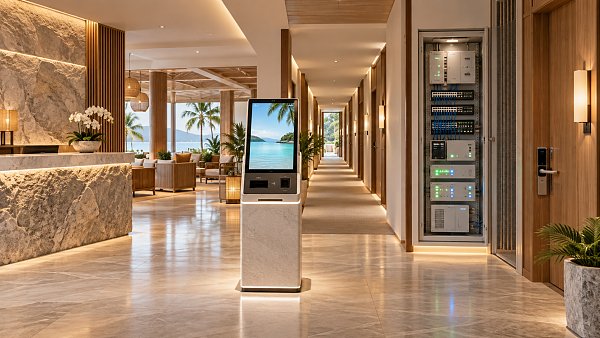
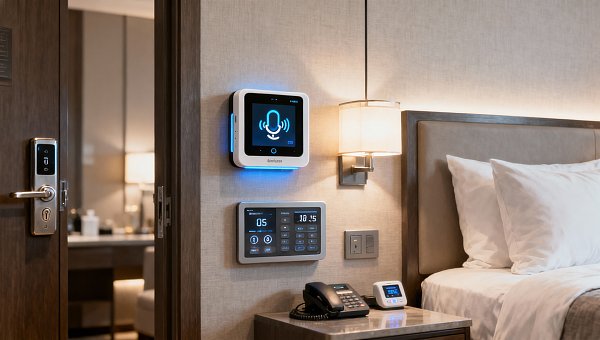
A resort can install a capable PMS, attractive guestroom controls, and modern self-service kiosks yet still create a fragmented stay. The failure usually appears at the handoffs: a guest checks in at a kiosk but the room remains in an unoccupied energy mode; a late checkout is approved in the PMS but the access credential expires; a room is marked vacant before housekeeping has completed its inspection.
For project managers, resort system integration should therefore be treated as an operating-model decision before it becomes an IT workstream. The first question is not whether each supplier supports integration. It is which business events must move between systems, who owns each event, and what happens when a connection is delayed or unavailable.
A useful starting point is to map the guest and room lifecycle across the property: reservation, pre-arrival, arrival, identity or payment verification, room assignment, credential issuance, in-stay service, maintenance response, checkout, housekeeping release, and room return to inventory. This exercise exposes the points where systems need to exchange a reliable status rather than merely display similar information.
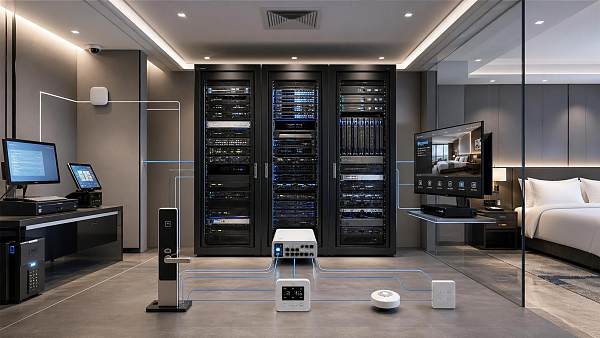
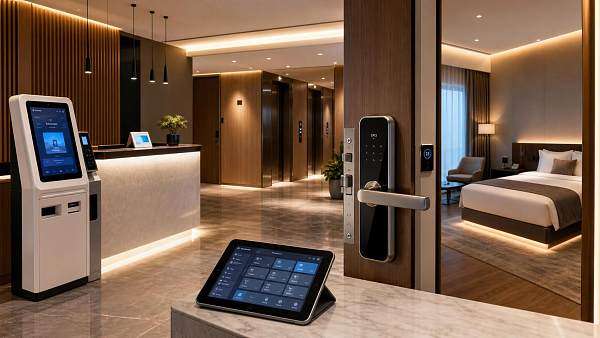
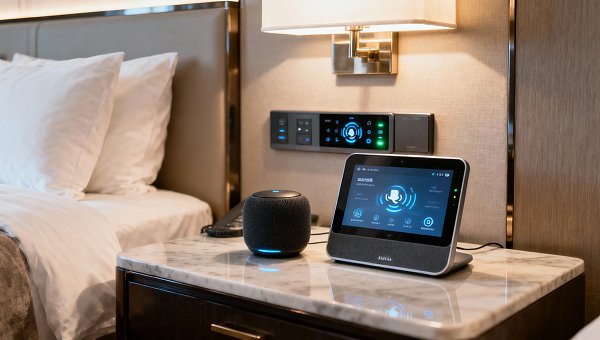
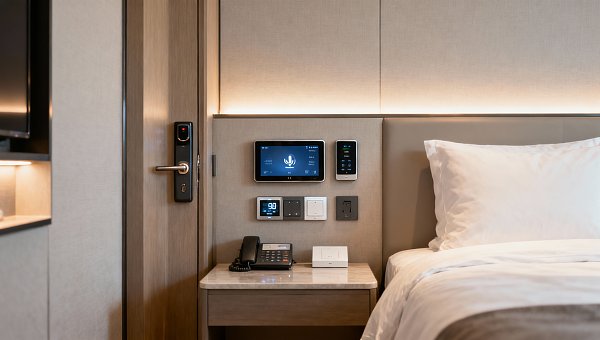
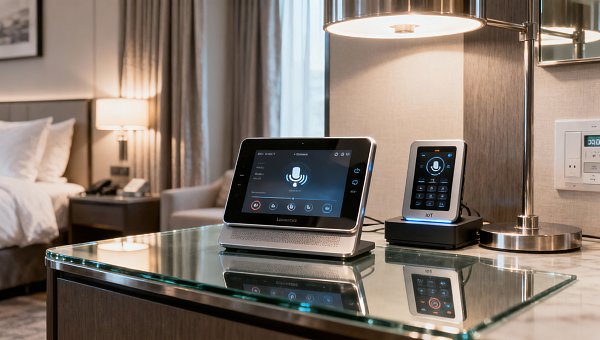
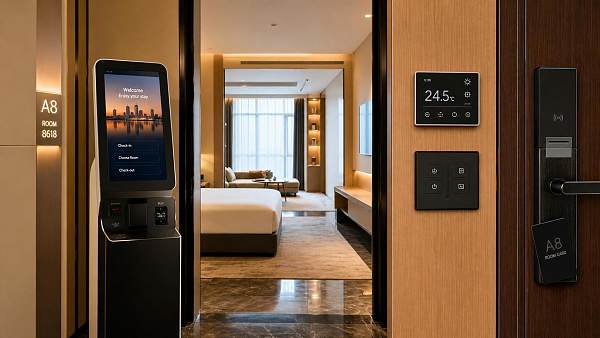
In most resort environments, the PMS should remain the commercial system of record for reservations, guest profiles, room assignment, and stay status. The guestroom management system should control room-level behavior such as HVAC setpoints, lighting scenes, occupancy logic, service requests, and selected device states. Kiosks should execute approved guest-facing transactions through governed connections to the PMS, payment services, identity tools, and credential-management platform. Keeping those ownership boundaries clear reduces duplicated data and conflicting commands.
Define the integration events that actually matter
Many integration scopes are described in broad terms such as “PMS connection” or “smart room enabled.” Those labels are inadequate for procurement, design coordination, and acceptance testing. Teams need an event-level definition of what the systems will exchange.
For a standard arrival flow, the relevant sequence may include:
- The PMS confirms that a reservation is eligible for check-in.
- The kiosk retrieves the permitted reservation details and completes the configured identity, payment, and registration steps.
- The PMS records the completed check-in, guest status, assigned accommodation, and authorized departure time.
- The credential system issues a room key or mobile access credential with a validity period tied to the stay.
- The PMS or integration layer sends an occupancy or checked-in event to the guestroom controls platform.
- The room enters a pre-arrival or occupied operating profile, rather than remaining in a deep energy-saving state.
Each step should have an owner, a source of truth, a target system, an expected response, and a fallback rule. This level of detail prevents a common design error: assuming that “check-in completed” automatically triggers every downstream action. It may not. One supplier may expose a reservation update but not a room-state event. Another may support credential creation but not changes to a shortened or extended stay. A room controller may accept an occupied signal but lack a defined process for erroneous assignments or room moves.
The same rigor is needed at checkout. A kiosk-initiated checkout should update the PMS first, but the downstream effect on access, HVAC, minibar workflows, housekeeping tasks, and guest notifications may require different timing rules. Immediate deactivation of access may be acceptable for an express checkout at departure time, but it can cause service disruption where guests are allowed a practical exit window. The operating policy must be designed before technical logic is set.
Room status requires particular discipline
Room status is one of the most frequently misunderstood integration points. “Vacant,” “dirty,” “clean,” “inspected,” “out of order,” “occupied,” and “do not disturb” do not always mean the same thing across the PMS, housekeeping application, building management layer, and guestroom controls platform. Treating these values as interchangeable produces unreliable automation.
Project teams should create a cross-system status matrix before configuration begins. It should state which system originates each status, which systems consume it, whether the status is advisory or authoritative, and which statuses can trigger an automated action. For example, a PMS checkout may trigger a guestroom controller to enter an unoccupied profile, while a housekeeping “room released” status may be the event that permits the PMS to offer the room for new assignment. Neither event should be inferred from a motion sensor alone.
Choose the architecture before selecting endpoints
There are three broad ways to connect PMS platforms, room controls, and kiosks: direct point-to-point integrations, a vendor-led platform, or an integration layer that brokers data among systems. None is automatically correct. The practical choice depends on property scale, brand requirements, vendor mix, and the expected frequency of change.
Direct connections can be workable for a limited deployment with stable systems and a narrow set of workflows. They may also be easier to understand during early commissioning because there are fewer components. Their weakness emerges when a resort adds mobile keys, a new payment provider, villas with a different control system, or a separate wellness and recreation operation. Every new connection can become a separate development, testing, support, and upgrade obligation.
A single-vendor platform can simplify responsibility when its PMS, guestroom automation, kiosk, and access components fit the project requirements. This approach deserves scrutiny rather than automatic approval. A common brand does not guarantee that the modules share complete data models, common security controls, or a mature implementation method. The project team should still request the same event catalogue, interface specifications, version commitments, and test evidence required of a multi-vendor deployment.
An integration layer is often appropriate where several specialized systems must coexist or where the ownership group expects future technology replacement. It can centralize transformations, logging, retries, monitoring, and access control. However, it is not a cure for undefined business rules. A middleware platform can transport an ambiguous room status more efficiently, but it cannot decide what that status should mean.
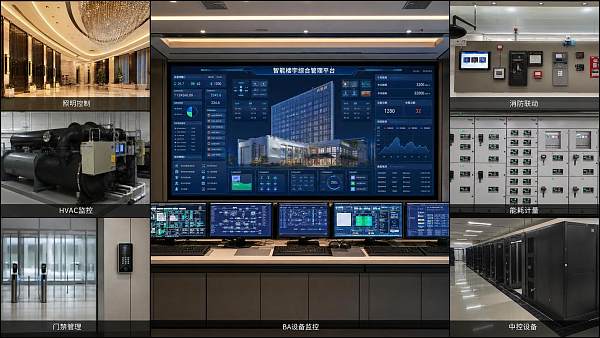
For resorts with villas, cabins, glamping units, or dispersed recreational zones, the physical architecture matters as much as the software architecture. Network resilience, local controller behavior, power recovery, wireless coverage, and remote support access should be considered at the same stage as API design. A guestroom control platform that depends on continuous cloud connectivity may behave differently from a locally managed controller when a site link fails. The intended guest experience during that failure should be documented, not left to vendor assumptions.
Test the difficult journeys, not only the happy path
Demonstrations tend to show a clean check-in for one guest, one room, and one reservation. Commissioning must focus on the conditions that create operational pressure: early arrivals, room changes, split stays, shared accommodations, late departures, manually assigned rooms, unavailable network links, payment exceptions, inaccessible rooms, and staff overrides.
A sound factory or pre-opening test plan should include both functional testing and operational recovery testing. Functional testing confirms that the expected message is sent and accepted. Recovery testing confirms that the property can continue to operate when a dependent system is slow, unavailable, or returns inconsistent information.
- Can front desk staff issue a credential when the kiosk is unavailable?
- Can the kiosk complete an arrival if the room-control platform is temporarily offline, and what room condition will the guest encounter?
- What occurs if a room move happens after a mobile credential has already been issued?
- Can a guest extend a stay without losing room access or resetting control preferences incorrectly?
- Does a controller recover the correct occupied, vacant, or fault state after power restoration?
- Are failed integration messages visible to an accountable operations or support team, rather than buried in a supplier log?
Acceptance criteria should state observable outcomes, not only interface availability. “PMS integration operational” is too vague to sign off. A stronger criterion might specify that, after a successful kiosk check-in, the assigned room receives the configured arrival profile within an agreed period, the credential works at the correct doors, and staff can view any exception requiring intervention. The requirement should also identify the environmental conditions used for the test, including network loss where relevant.
Projects benefit from a formal end-to-end test script owned jointly by operations, IT, security, front office, housekeeping, and engineering. Technical teams can confirm message delivery, but operating departments are best placed to identify whether the result supports the real service process. This also reduces the risk of discovering workflow gaps after guests have arrived.
Security and privacy are design constraints, not post-handover tasks
Connecting these systems expands the number of places where guest, reservation, payment, access, and occupancy-related data may be stored or transmitted. The appropriate principle is data minimization. A room controller rarely needs the full guest profile; it may only require a room identifier, occupancy state, stay window, and selected preference data that the resort has chosen to use.
Integration design should document what data crosses each interface, where it is stored, how long it is retained, and which service account or user role can access it. Suppliers should be required to explain authentication methods, encryption in transit, credential rotation, audit logs, software update procedures, vulnerability response, and remote support controls. These questions are particularly important where kiosks process identity documents or payment-related information and where smart-room networks connect to operational technology assets.
Segmentation also matters. Guest Wi-Fi, kiosk networks, administration systems, IoT controllers, and building systems should not be treated as one flat environment simply because they share a physical site. The exact network design will vary, but the objective is consistent: compromise or failure in one area should have limited ability to disrupt access control, room operations, or core reservation functions.
Build governance into the handover package
The operational life of an integrated resort system is shaped less by launch-day presentations than by how changes are governed afterwards. PMS updates, kiosk software releases, credential changes, room-control firmware, new guest journeys, and brand technology mandates can all affect working interfaces.
Before handover, the owner or operator should have a clear integration register containing interface owners, supported versions, message definitions, monitoring responsibilities, escalation routes, backup procedures, and change-approval rules. The register should identify whether a vendor is responsible for fixing its endpoint, diagnosing cross-platform faults, or coordinating with a third-party integration provider. Ambiguity at this point tends to surface as prolonged outages and disputes during peak occupancy.
It is also sensible to distinguish operational alerts from technical alerts. A failed temperature reading may be a maintenance issue; a mismatch between occupied status and an unassigned room may require front office intervention; repeated interface failures may need IT escalation. Routing all alerts to one group creates noise and delays meaningful action.
The strongest resort system integration programs make the PMS, guestroom controls, and kiosks behave as parts of one service operation while preserving clear ownership of data and decisions. That balance comes from a defined event model, a deliberate architecture, realistic failure testing, and support governance that lasts beyond opening. When those elements are established early, technology can improve arrival flow, room readiness, energy operations, and staff response without making the property dependent on fragile automation.
Recommended News
 Sep 25, 2026Resort System Integration: How to Connect PMS, Guestroom Controls, and KiosksResort system integration guide: connect PMS, guestroom controls, and kiosks with reliable workflows, secure data, and seamless guest experiences.
 Sep 08, 2026How to Build Stable Interoperability Across Hotel Guestroom SystemsHospitality system interoperability stable: learn how hotels can align room states, command priorities, local fallback, and testing for reliable guestroom operations.
 Aug 18, 2026What Hotel System Interoperability Means for PMS, POS, and Guestroom TechHotel system interoperability shapes how PMS, POS, and guestroom tech perform in real hotels. Learn the key risks, validation points, and smarter ways to build resilient operations.
 Aug 10, 2026How to Evaluate a Smart Hotel System Integration Quotation Before ApprovalSystem integration quotation for smart hotels: learn how to assess scope, interoperability, cybersecurity, lifecycle cost, and hidden risks before approval.
 Jul 28, 2026How to Evaluate a Smart Hotel Application for Guest Experience and Staff EfficiencySmart hotel application evaluation made practical: learn how to compare integrations, guest journey design, staff workflows, security, and total cost to choose a smarter hotel solution.
 Jul 12, 2026Premium Camping Q2 Up 19% as Europe Expands Guestroom AutomationPremium camping grew 19% in Q2 as Europe accelerates guestroom automation. Discover how Germany, France, and Switzerland are driving demand for smarter campsites.
 Jul 11, 2026System Integration Testing for Resorts: Key Steps Before Guestroom Tech Goes LiveSystem integration testing for resorts: discover the 6 essential pre-opening steps to prevent guestroom tech failures, reduce launch risk, and protect guest satisfaction.
 Jul 10, 2026Hospitality System Interoperability Buyer Guide: What to Check Before You BuyHospitality system interoperability buyer guide: learn what to verify before you buy, from APIs and device compatibility to security, scalability, hidden costs, and vendor risk.
 Jul 09, 2026CPSC advisory puts offline AI checks on hotel voice devicesCPSC advisory reshapes compliance for hotel voice devices with offline AI. Learn how FCC Part 15 checks, labeling, and shipment readiness may impact U.S. hotel projects.
 Jul 08, 2026CPSC Sets Offline AI Rule for Guestroom Voice ModulesCPSC Sets Offline AI Rule for Guestroom Voice Modules: learn how the 2026 U.S. update impacts compliance, imports, hotel tech sourcing, and recall risk for suppliers.
 Jul 07, 2026CPSC Sets Offline AI Bar for Hotel Voice DevicesCPSC sets a new offline AI bar for hotel voice devices. Learn how the 2026 guidance impacts guestroom automation, import checks, supplier compliance, and hotel procurement decisions.
![]() Jul 06, 2026CPSC Requires Offline AI in Guestroom Voice SystemsCPSC requires offline AI in guestroom voice systems starting Oct 1, 2026. Learn how this rule impacts Alexa/Google integrations, compliance, procurement, and U.S. market shipments.
 Jul 06, 2026How to Reduce Hospitality System Interoperability Latency Across PMS, POS, and IoTHospitality system interoperability latency affects guest experience, revenue accuracy, and IoT responsiveness. Learn practical ways to reduce delays across PMS, POS, and smart hotel systems.
 Jul 05, 2026CPSC Orders Offline AI for Hotel Voice ModulesCPSC orders offline AI for hotel voice modules by Oct 1, 2026. Learn how local AI inference rules will impact U.S. hotel automation sourcing, integration, and compliance.
 Jul 04, 2026CPSC Mandates Offline AI for Guestroom Voice UnitsCPSC mandates offline AI for guestroom voice units entering the U.S. Learn how FCC Part 15B and UL 60730-1 compliance will reshape hotel procurement, OEM design, and delivery plans.
 Jul 03, 2026CPSC Requires Offline AI for Guestroom Voice ModulesCPSC Requires Offline AI for Guestroom Voice Modules: learn what the emergency U.S. rule means for compliance, sourcing, hotel tech procurement, and avoiding delisting or fines.
 Jul 02, 2026CPSC Requires Offline AI for Hotel Voice DevicesCPSC Requires Offline AI for Hotel Voice Devices: learn how the new U.S. rule impacts hotel automation, OEM/ODM suppliers, and guestroom voice compliance.
 Jul 01, 2026CPSC Orders Offline Voice Processing for Hotel Room SystemsCPSC orders offline voice processing for hotel room systems, making cloud-based voice control a live compliance risk. Learn what manufacturers, exporters, and hotel buyers must review now.
 Jul 01, 2026System Integration Testing for Smart Buildings: What to Verify Before HandoverSystem integration testing smart building projects must verify interoperability, alarms, cybersecurity, and data quality before handover. Learn what to check for a safer, smoother launch.
 Jun 28, 2026UL Tightens Guestroom Automation Rules on AI Voice DataUL tightens Guestroom Automation rules on AI voice data from Oct. 1, 2026. Learn how UL 2900-3:2026 affects certification, product design, and U.S. export readiness.
 Jun 26, 2026Smart Hospitality in Southeast Asia: Which Guestroom Automation Features Matter Most?Smart hospitality Southeast Asia is reshaping hotel operations. Discover which guestroom automation features truly boost guest satisfaction, efficiency, and long-term asset value.
 Jun 23, 2026How Smart Hospitality Solutions Improve Check-In, Energy Control, and Guest ExperienceSmart hospitality solutions improve check-in speed, energy control, and guest experience by aligning automation with property type, occupancy patterns, and operational performance.
 Jun 22, 2026Germany Sets TR-03147 Rule for Guestroom AutomationGermany sets TR-03147 V2.1 rule for Guestroom Automation from Oct 1, 2026. Learn CE marking impacts, cybersecurity requirements, and what suppliers, buyers, and exporters must do now.
 Jun 21, 2026Germany Sets Mandatory Cybersecurity Certification for Guestroom AutomationGermany Sets Mandatory Cybersecurity Certification for Guestroom Automation: learn how TR-03163-2 rules from April 2027 will impact hotel tech vendors, integrators, and buyers in Germany.
Quarterly Executive Summaries Delivered Directly.
Join 50,000+ industry leaders who receive our proprietary market analysis and policy outlooks before they hit the public library.