Search News
TerraVista Metrics (TVM)Industry Portal
TerraVista Metrics (TVM)Hot Articles
TerraVista Metrics (TVM)- Choosing an Amusement Equipment Testing Agency: Accreditation and ScopeChoosing an amusement equipment testing agency? Learn how to verify accreditation, assess technical scope, and compare reports before you commit.
- Global Temporary Buildings Market Forecast to Reach $5.88 Billion by 2032Global temporary buildings market is forecast to reach $5.88 billion by 2032. Explore the modular, reusable and rapid-assembly trends driving growth.
- Product Benchmarking: How to Compare Material Performance and DurabilityMaster product benchmarking and material comparison with practical tips for evaluating test data, durability and lifecycle costs. Make confident purchasing decisions.
Popular Tags
TerraVista Metrics (TVM)Industry NewsHow Much Does an Eco Cabin Cost Including Delivery and Installation?
auth.Julian Thorne (Sustainable Infrastructure Architect)Time
Nov 07, 2026Click Count
How much does an eco cabin cost once delivery and installation are included? The answer is the price of the cabin plus everything required to make it legally usable on your particular site. Freight and lifting are only part of that difference. Foundations, access improvements, utility connections, local approvals, and commissioning can all sit outside an advertised unit price.
For tourism developers and glamping operators, this distinction matters before the deposit is paid. A cabin may look ready for guests in a supplier’s photographs while still requiring significant work after arrival. The reliable budgeting question is not simply “What does this unit cost?” It is “What will it cost to open this accommodation, at this location, with these specifications?”
There is no defensible universal installed price without knowing the country, cabin size, construction system, site conditions, and scope of supply. Rather than presenting an unsupported market average, this guide explains how to build a site-specific budget and compare quotations using TerraVista Metrics’ engineering-led approach to procurement.
Define the finish line before comparing prices
“Delivered,” “installed,” and “turnkey” can describe very different packages. One supplier may include transport to the site entrance. Another may include crane placement onto prepared foundations. Neither necessarily includes drainage, electrical connections, inspections, or furniture.
Before requesting prices, choose the completion standard you need:
For a hospitality project, guest-ready cost is usually the most useful decision metric. Keep land acquisition and wider resort development separate, but do not omit their relevant infrastructure costs when assessing project viability.
Build the installed eco cabin cost from identifiable components
A practical budgeting equation is:
Total guest-ready cost = specified cabin + delivery and unloading + site preparation and foundations + installation + utility connections + approvals and professional fees + operating fit-out + applicable taxes and duties + contingency.
Each component needs an owner, a scope, and a price basis. “Included” is useful only when the contract explains exactly what is included.
The cabin itself: compare the same building, not the same photograph
Start with usable internal floor area, layout, structural system, insulation, glazing, bathroom specification, kitchen provision, and heating or cooling equipment. Confirm whether decks, exterior stairs, roof projections, and furniture are included or optional.
A low factory price may reflect a basic shell rather than finished accommodation. Conversely, a more expensive unit may arrive with substantial services and finishes already installed, reducing local work. Neither approach is automatically better; the total cost depends on local labor, transport constraints, and approval requirements.
Ask for a specification schedule that identifies materials and performance values. Words such as “premium insulation” and “eco-friendly construction” are not substitutes for measurable information.
Delivery: route feasibility comes before freight pricing
Transport depends on the cabin’s shipping dimensions and weight, not just its floor area. A complete volumetric cabin may require oversized-load arrangements, while a panelized structure may travel more compactly but need additional assembly at the destination.
Request a logistics assessment covering the entire route. Narrow bridges, overhead lines, tight turns, steep gradients, seasonal road restrictions, and soft ground can change the delivery plan. The final approach through a rural property may be more difficult than the long-distance journey.
For imported cabins, identify responsibility for export handling, ocean freight, port charges, customs clearance, duties, inland transport, and cargo insurance. A named Incoterm helps establish responsibilities, but it does not replace a detailed destination-cost schedule.
Groundworks and foundations: price the actual site
A foundation design should respond to soil conditions, structural loads, wind exposure, drainage, and local requirements. Do not assume that screw piles, concrete pads, or a slab are suitable simply because another project used them.
Groundworks may include vegetation clearance, grading, excavation, drainage, retaining works, and temporary access. Sloping sites can also require more expensive decks and access arrangements.
Obtain the supplier’s support-point layout and loading information before asking a local contractor to quote. If the foundation proposal is based on incomplete structural information, the initial price may not survive engineering review.
Installation: the lift is only one part of the job
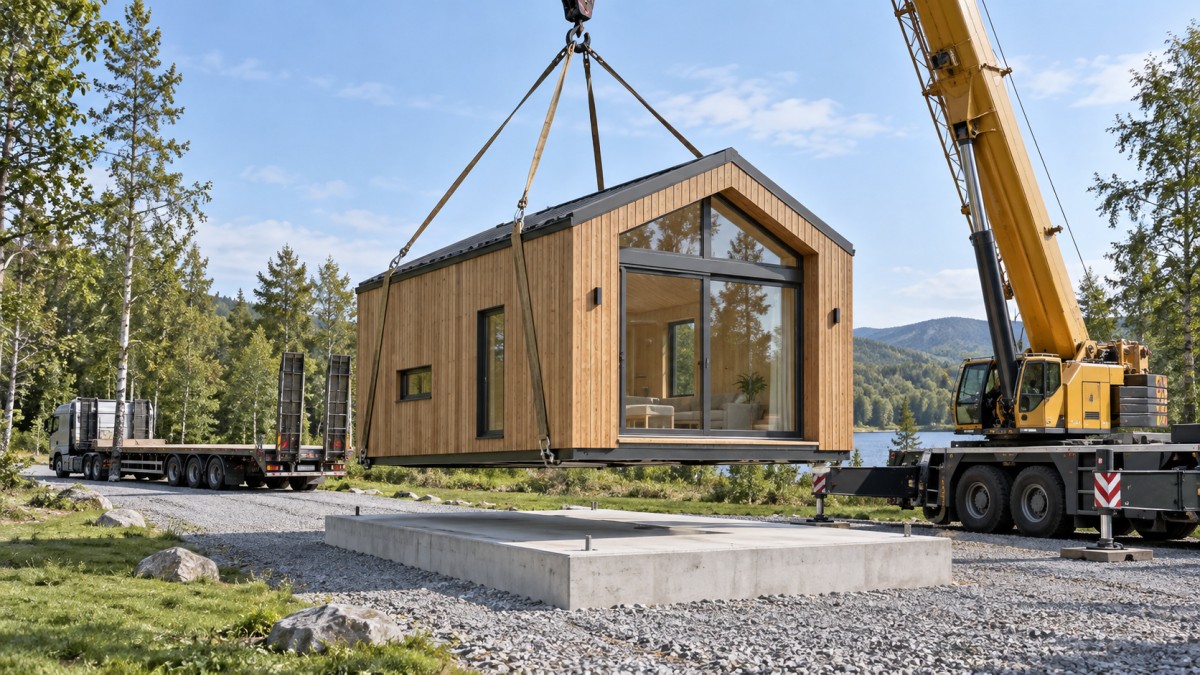
Crane costs depend on the required reach, lifting weight, ground conditions, setup space, and booking duration. A cabin positioned close to an accessible road presents a different lifting task from one placed behind trees or across a slope.
Installation may also involve joining modules, sealing interfaces, fitting roof elements, connecting internal services, installing steps, and completing finishing work. Confirm who supplies lifting accessories and who approves the lifting method.
Delays create another exposure. If the cabin arrives before foundations are ready, storage, repeat transport, crane cancellation, or additional contractor attendance may follow.

Utilities: measure the distance to a usable connection
“Utilities nearby” is not a budget. Establish the location, capacity, and condition of the actual connection points, then measure the route to each cabin.
Electricity may require trenching, distribution equipment, capacity upgrades, metering, and testing. Water connections need adequate pressure and suitable protection for the climate. Wastewater may require connection to an existing system or a separately designed treatment solution.
Off-grid systems shift these costs rather than remove them. Solar generation, batteries, backup power, water storage, filtration, and wastewater treatment need sizing around occupancy and seasonal demand.
Check whether the “eco” specification justifies its cost
An eco cabin is not a single standardized product category. The label may refer to timber construction, recycled content, efficient insulation, renewable energy equipment, or simply a nature-oriented appearance.
TerraVista Metrics’ benchmarking perspective is useful here: separate marketing claims from engineering evidence. Evaluate what each feature changes in capital cost, operating demand, durability, and maintenance.
- Thermal performance: Request insulation values, glazing specifications, and information about thermal bridges. Where available, examine whole-building performance rather than one material in isolation.
- Climate suitability: Check moisture management, ventilation, corrosion protection, and relevant wind or snow-load design requirements.
- Material evidence: Ask for documentation supporting recycled-content, responsible-sourcing, or environmental claims, including the scope and validity of any certification.
- Serviceability: Establish whether replacement parts and qualified technicians are available locally.
- Hospitality durability: Assess finishes, fixtures, and furniture against frequent cleaning and repeated guest turnover.
A higher-performance envelope may reduce heating and cooling demand, but savings depend on climate, occupancy, energy tariffs, and system operation. Model those assumptions instead of accepting a promised payback period.
Turn supplier quotations into a comparable budget
The easiest way to misread competing offers is to compare their headline totals. Instead, issue the same scope to each supplier and move every quotation into a shared cost schedule.
Send one project brief to everyone
Include the site location, intended hospitality use, cabin quantity, floor plan, occupancy, climate conditions, target completion date, and required completion standard. Add available surveys, access photographs, utility information, and known planning constraints.
Specify whether quotations must include foundations, delivery, unloading, installation, connections, taxes, and commissioning. Where a supplier cannot price an item, require an explicit exclusion rather than silence.
Separate fixed prices from unresolved allowances
Classify each line as a confirmed price, provisional allowance, owner-supplied item, or excluded scope. Record quotation validity, currency, payment milestones, and conditions that permit price changes.
This exposes the real difference between offers. A cheaper quotation with unresolved freight and installation may carry more budget uncertainty than a higher quotation with those items contractually defined.
Watch for double-counting as well. Unloading might appear in both the transport contractor’s price and the installation package. Utility connection work may overlap with a site contractor’s scope.
Resolve compliance before placing the order
A supplier’s factory documentation does not automatically establish that the cabin can be occupied at your destination. Planning rules, building requirements, fire safety, accessibility, wastewater approvals, and hospitality licensing vary by jurisdiction and use.
Ask a qualified local professional to review the proposed unit and site arrangement early. Clarify whether adaptations are required and who will provide the necessary drawings, calculations, inspection access, and completion documentation.
Late compliance changes can affect both the cabin specification and the site works. They are particularly disruptive once manufacturing has started.
For multiple cabins, distinguish shared infrastructure from unit costs
A glamping development should not be budgeted by multiplying one cabin quotation by the number of units. Shared infrastructure creates a separate cost layer.
Access roads, electrical distribution, wastewater treatment, water storage, paths, lighting, and communications may serve the whole site. Allocate these costs transparently rather than hiding them inside an average cabin price.
Effective cost per guest-ready cabin = total accommodation-related capital cost ÷ number of completed, usable cabins.
This calculation needs care in phased developments. If the first phase pays for infrastructure designed to serve later expansion, report both the first-phase cash requirement and the eventual allocation across the planned development. Future cabins do not finance today’s invoices.
Also test delivery sequencing. Combined transport or installation mobilization may reduce repeated costs, but only if the route, lifting plan, site readiness, and supplier schedule support it.
Protect the budget where uncertainty remains
Contingency should reflect project risk, not an arbitrary amount added to make a spreadsheet look complete. Identify unresolved ground conditions, access constraints, exchange-rate exposure, permitting changes, and incomplete utility designs.
Distinguish contingency from known but unpriced work. If wastewater treatment is required, it belongs in the base scope as an allowance until quoted—not in a miscellaneous reserve.
Before committing, confirm that:
- The delivery route and unloading location have been assessed.
- Foundation requirements match the cabin’s structural information.
- Utility capacity and connection responsibilities are documented.
- Local approval requirements have been reviewed.
- Installation exclusions and handover tests are written into the scope.
- Warranty terms identify responsibility for transport damage, installation defects, and service failures.
The price to trust is the one tied to a complete scope
When asking how much an eco cabin costs including delivery and installation, request a site-specific, itemized quotation—not a percentage uplift on the advertised price. The same cabin can produce very different completed costs on an accessible serviced site and a remote, undeveloped plot.
For tourism procurement, the strongest decision combines a guest-ready capital budget with verified performance information and realistic operating assumptions. That is where TerraVista Metrics’ emphasis on technical benchmarking, compliance analysis, and supply-chain intelligence becomes relevant: understanding what you are buying before deciding whether its price represents value.
A compelling cabin photograph can start the conversation. A documented scope, feasible delivery plan, and clear handover standard should finish it.
Recommended News
 Nov 04, 2026ICC Expert Examines Code Readiness for Modular ConstructionModular construction codes are evolving. Explore ICC expert insights on off-site compliance, technical integration and the ICC/MBI 1200 standards.
 Nov 04, 2026Choosing an Eco Cabin Certification Company: Standards and CredentialsChoosing an eco cabin certification company? Learn how to verify credentials, assess standards and compare evidence before you invest.
 Nov 01, 2026Choosing an H-Type Automatic Cage System for 30,000+ Laying HensChoosing a >30000 Layers H Type Automatic Battery Cage? Compare capacity, ventilation, welfare, automation and costs before investing.
 Oct 28, 2026Modular Homes Draw Canton Fair Buyers as Chinese Manufacturing Expands OverseasModular homes draw Canton Fair buyers as Chinese manufacturers expand overseas. Explore customization opportunities and standards checks to guide smarter procurement decisions.
 Oct 21, 2026Prefab Cabin Integration Testing: Power, HVAC, and Controls Checks Before DeliveryExplore prefab integration testing for cabins to verify power, HVAC, controls, and fault recovery before delivery. Discover key checks to reduce risk and make confident acceptance decisions.
 Oct 29, 2026How Do I Choose Regional Lifecycle Data for Imported Cabin Materials?How do I choose regional lifecycle data for imported cabin materials? Learn to compare EPDs, match production regions, and assess transport impacts for smarter procurement decisions.
 Oct 28, 2026Do Locally Sourced Cabins Always Have a Lower Carbon Footprint?Do locally sourced cabins always have a lower carbon footprint? Discover how materials, transport, energy use, and lifespan affect emissions—and make smarter cabin sourcing decisions.
 Oct 27, 2026How Can I Keep Cabin Installation Delays From Delaying a Resort Opening?How do I keep cabin installation delays from pushing back a resort opening? Discover practical steps for permits, site readiness, and phased launches to protect your opening date.
 Oct 20, 2026What Is Modular Tourism, and Where Do Prefab Guest Cabins Make Sense?Explore modular tourism and discover where prefab guest cabins work best. Compare site access, approvals, infrastructure, and costs to plan a smarter tourism investment.
 Oct 19, 2026How Do You Prevent Condensation Inside an Eco Cabin?How do I stop condensation inside an eco cabin? Discover practical ventilation, humidity control, and insulation tips to reduce dampness and keep your cabin dry and comfortable.
 Oct 18, 2026How Much Does an Eco Cabin Cost Including Delivery and Installation?How much does an eco cabin cost once delivery and installation are included? Discover hidden site costs, compare quotes, and build a reliable guest-ready budget before you buy.
 Oct 17, 2026Why Is a Well-Insulated Cabin Still Expensive to Cool?Why is a well-insulated cabin still expensive to cool? Uncover hidden solar gain, air leaks, humidity, and HVAC issues—and learn how to cut cooling costs without sacrificing comfort.
 Oct 16, 2026Can a Modular Cabin Be Relocated Without Voiding Its Warranty?Can a modular cabin be relocated without losing its warranty? Discover the approval, transport, and reinstallation steps that help protect coverage and avoid costly relocation mistakes.
 Oct 15, 2026Do Cracks Around Cabin Joints Require an Engineering Inspection?Do cracks around cabin joints need an engineering inspection? Discover key warning signs, when monitoring is appropriate, and how to choose the right next step before repairs.
 Oct 15, 2026How Do You Verify a Prefab Cabin's Wind-Load Rating?How do I verify a prefab cabin's wind-load rating? Discover the engineering reports, site checks, and anchorage details you need to assess supplier claims and buy with confidence.
 Oct 14, 2026What Makes Eco Cabins Sustainable? Materials, Energy Use, and Site ImpactWhat makes eco cabins truly sustainable? Explore materials, energy use, and site impact, plus the evidence you need to compare options and make smarter, greener choices.
 Sep 22, 2026Industrial Compressors: How to Size Air Capacity and Pressure for Factory DemandIndustrial compressors sizing guide: calculate factory air capacity, end-use pressure, peak demand, receiver storage, leakage, and energy-efficient system performance.
 Sep 09, 2026Sustainable Building Materials Pricing: How Buyers Compare Cost, Life Cycle, and RiskSustainable building materials pricing explained: compare installed cost, life-cycle value, carbon evidence, and supply-chain risk for smarter procurement decisions.
 Aug 29, 2026How to Assess Modular Building Suitability for Middle East Climate and Site ConditionsModular building assessment Middle East: evaluate heat, dust, corrosion, logistics, compliance, and lifecycle value for resilient site-ready projects.
 Aug 16, 2026EU Sets Mandatory Carbon Footprint Certification for Imported Modular CabinsEU mandatory carbon footprint certification will reshape imported modular cabins compliance from 2027. Learn key EU rules, EN 15804+A2 impacts, exporter risks, and how to prepare early.
 Aug 12, 2026New Exit Compliance Rule Reshapes Bids and AI Travel ProofExit compliance rule now reshapes bids and AI travel proof, raising export compliance demands for glamping tents, modular cabins, smart lighting, and kiosk tech. Learn what changes first.
 Jul 13, 2026EU Fire Rule Tightens Testing for Modular CabinsEU Fire Rule Tightens Testing for Modular Cabins: learn how EN 13501-1:2026 shifts CE compliance to component fire testing, impacts lead times, and affects EU export planning.
 Jul 12, 2026Prefab Thermal Efficiency Analysis: Which Metrics Matter for Off-Grid Cabin Design?Prefab thermal efficiency analysis for off-grid cabins: discover the key metrics that shape energy use, comfort, moisture control, and smarter supplier selection.
 Jul 11, 2026EN 16893:2026 Takes Effect for Modular CabinsEN 16893:2026 takes effect for modular cabins in the EU, making third-party verification essential for customs, listing, and project approval. Learn the key compliance changes now.
{item.publish_time}{item.title}{item.description}Quarterly Executive Summaries Delivered Directly.
Join 50,000+ industry leaders who receive our proprietary market analysis and policy outlooks before they hit the public library.