Search News
TerraVista Metrics (TVM)Industry Portal
TerraVista Metrics (TVM)Hot Articles
TerraVista Metrics (TVM)- Industry Reports Library: How to Find Reliable Data for Market ResearchExplore an industry reports library to find reliable market data, verify sources, and compare findings. Learn practical steps to turn research into confident business decisions.
- Do Cracks Around Cabin Joints Require an Engineering Inspection?Do cracks around cabin joints need an engineering inspection? Discover key warning signs, when monitoring is appropriate, and how to choose the right next step before repairs.
- How Do You Verify a Prefab Cabin's Wind-Load Rating?How do I verify a prefab cabin's wind-load rating? Discover the engineering reports, site checks, and anchorage details you need to assess supplier claims and buy with confidence.
Popular Tags
TerraVista Metrics (TVM)Industry NewsDo Cracks Around Cabin Joints Require an Engineering Inspection?
auth.Julian Thorne (Sustainable Infrastructure Architect)Time
Oct 15, 2026Click Count
Cracks around cabin joints require an engineering inspection when they suggest movement in the supporting structure, damage to a connection, or deterioration that could affect load-bearing components. A stable crack confined to paint or a finish layer is often a maintenance issue. A widening gap, displaced panel, damaged fastener, or crack accompanied by floor movement deserves a different response. Crack width alone cannot establish whether a cabin is structurally sound.
The first task is to identify what has cracked: the decorative finish, the weather seal, the underlying material, or the connection between structural elements. That distinction determines whether the next step is finish repair, investigation of water entry, documented monitoring, or assessment by a qualified structural engineer.
Identify which part of the joint is opening
A cabin joint can contain several layers serving different purposes. An exterior seam may include cladding, sealant, flashing, insulation, and a concealed frame connection. Inside, a plasterboard crack might follow the same line without exposing any structural component. Two cracks in the same location can therefore have very different significance.
Begin with accessible observations. Record whether the crack runs through paint, follows the edge of a sealant bead, crosses a timber member, or emerges beside a connector. Avoid removing structural fixings or opening concealed assemblies without an agreed investigation method. Disturbing the joint can erase evidence and create additional damage.
The joint’s intended function matters. An expansion joint is designed to accommodate movement; a rigid structural connection has a different purpose. Compare the observed condition with drawings and installation details whenever available. An intentional gap should not be filled simply because it resembles a defect.
Signs that justify an engineering inspection
Arrange an inspection when joint cracking is progressive, involves structural materials or connectors, or appears alongside a change in the cabin’s shape or support conditions. Several related symptoms carry more weight than an isolated surface blemish.
- A crack continues to lengthen or open across successive observations, particularly when temperature and moisture conditions are comparable.
- Adjacent modules or panels have moved out of alignment. Look for a step across the joint, separation at a bearing point, or newly uneven floor levels.
- Doors or windows suddenly bind while nearby wall joints crack. A swollen door alone has several possible explanations, but combined distortion warrants investigation.
- Visible structural connections show withdrawn fasteners, bent plates, torn holes, cracked welds, or timber splitting through a fastener group.
- Cracking appears after a significant event such as impact, flooding, strong winds, relocation, or nearby excavation.
Sudden separation, visible instability, loss of bearing, or substantial deformation requires immediate restriction of access to the affected area and urgent professional assessment. Routine monitoring is inappropriate while an active failure is suspected. Do not enter beneath a displaced cabin or attempt to restore its position with improvised jacking.
Water intrusion also changes the decision. A failed weather seal does not automatically indicate structural damage, but repeated wetting can deteriorate timber, corrode concealed steel, and weaken some panel materials. Persistent leakage near a load-bearing joint needs investigation of both the entry route and the condition of the supporting assembly.
Why similar cracks can have different causes
Timber responds to moisture changes, while metal framing changes dimension with temperature. Finishes and cladding do not necessarily move at the same rate as the frame. Where these materials meet, a rigid filler or poorly detailed seal can crack even when the supporting structure remains stable. Seasonal recurrence becomes useful evidence when the pattern is documented alongside environmental conditions.
A split in timber requires attention to its position and direction. Surface checking away from a connection differs from splitting that crosses bolt holes, reduces the effective connection area, or accompanies crushing at a bearing surface. The visible opening cannot reveal the remaining connection capacity by itself.
In prefabricated cabins, module interfaces deserve particular attention because loads must transfer through specified connections and supports. Transport and lifting can also leave finish damage. A crack documented immediately after delivery has a different history from one that develops after installation, although neither history alone proves the condition harmless.
Support movement is another possible cause. Local erosion, inadequate drainage, or changing ground conditions can alter the relative position of piers or footings. Clues include gaps at support interfaces, movement concentrated at one corner, and related floor distortion. New cracks following relocation also justify reviewing the placement and installation records.
Timing helps distinguish these mechanisms. Record whether the crack followed heavy rain, a dry period, a temperature change, delivery, or alterations to the cabin. Removing a wall, adding roof equipment, or changing support positions can alter structural behavior and should be disclosed during an inspection.
Build a useful record before covering the joint
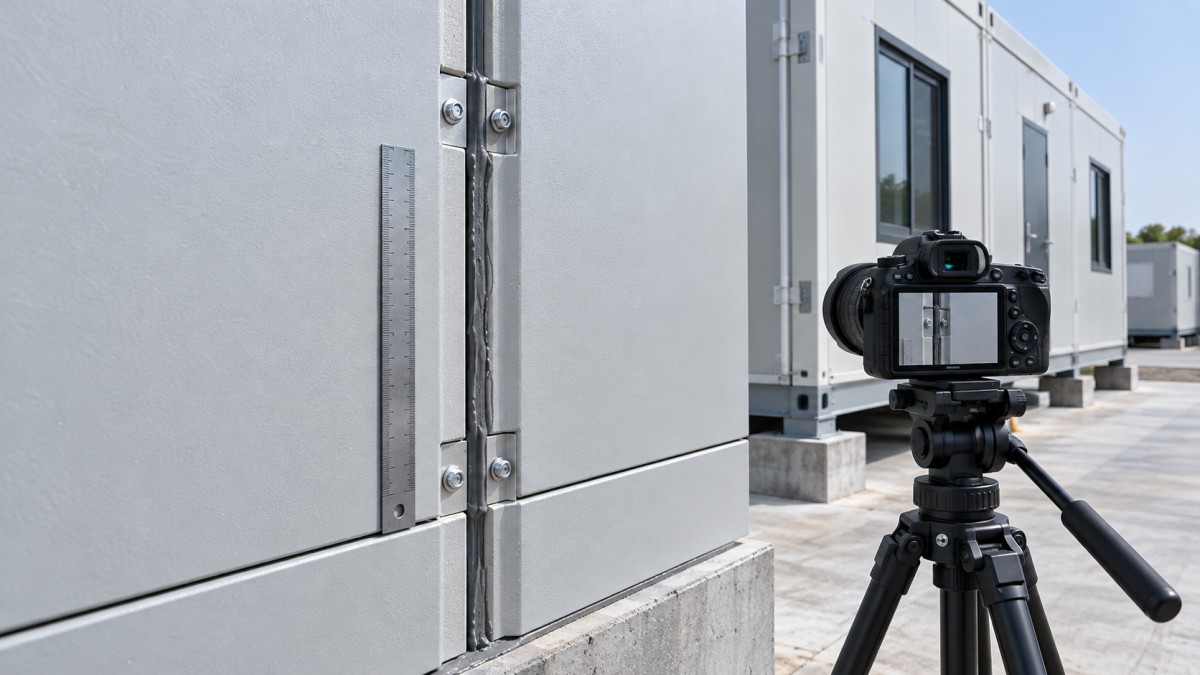
A clear record makes the inspection more productive and helps distinguish active movement from an old defect. Photograph the whole wall or cabin elevation first, then the joint, then the crack close up. Include a scale in the close-up and identify the location consistently so later photographs show the same feature.

Record the date, crack position, approximate length, and width at identifiable points. Note any displacement across the joint separately from the opening width. A narrow crack with an offset can be more significant than a wider gap in a flexible weather seal.
- Map related symptoms. Include nearby sticking openings, floor irregularities, stains, and visible support changes. Their relative positions help establish whether one movement pattern explains them.
- Gather available structural drawings, connection details, installation photographs, and records of transport damage or previous repairs. Missing records should be identified explicitly.
- Describe recent changes. Record unusual weather, drainage work, added loads, impact, and alterations. Separate observations from assumptions about the cause.
- Leave the crack visible until its significance has been assessed, unless temporary weather protection is needed. Document any temporary treatment and avoid concealing connectors.
Measurements need consistent reference points. Comparing different parts of an irregular crack can create an apparent change that is only a measurement difference. Photographs taken at an angle also distort apparent width. Where monitoring is appropriate, use repeatable methods and a schedule agreed with the inspecting professional.
Use monitoring only when the initial assessment supports it
Monitoring is useful for a stable finish crack or a joint whose movement needs to be characterized after initial assessment. It should not delay investigation of displaced structural connections or progressive deformation. A crack that has stopped changing is not proof that the underlying structure has adequate capacity.
There is no universal crack-width threshold that separates cosmetic damage from structural concern across all cabin types. Material, connection geometry, location, movement direction, and loading all affect the interpretation. A numerical limit taken from a different construction system can give false reassurance.
Temperature and moisture deserve a place in the record. A joint measured during a cool morning and again on a hot afternoon may show reversible movement. Compare readings under similar conditions where practical, while retaining the full history. Repeated opening and closing can still damage seals or finishes even when movement is expected.
The monitoring plan should state what triggers another inspection: measurable progression, new displacement, additional cracks, worsening door operation, or renewed leakage. Its duration and measurement method should follow the suspected mechanism. Waiting for a fixed number of weeks without a defined escalation point adds little useful evidence.
What the engineering inspection needs to resolve
The inspection should connect the visible defect to the cabin’s structural arrangement. That means considering how roof and floor loads reach the supports, how modules connect, and whether the affected joint participates in resisting wind or other lateral forces. Examining only the surface crack can leave the cause unresolved.
Accessible connections and support interfaces provide direct evidence. Depending on the findings, targeted opening of finishes, level measurements, moisture assessment, or specialist examination of damaged connections may be required. A limited visual inspection should clearly identify concealed areas that remain unverified.
Request a written assessment that distinguishes observed conditions from inferred causes. It should describe the inspected locations, any access limitations, whether further investigation is necessary, and the basis for repair or monitoring recommendations. Where occupancy restrictions are needed, the affected area and conditions for reopening should be stated clearly.
If movement originates at a support, repairing the wall joint alone will not resolve it. If the structure is stable but the weather seal cannot accommodate expected movement, the repair needs an appropriate joint detail. These are different repair scopes, even when the visible symptom is the same opening.
Repair the cause before restoring the finish
Resealing a joint is appropriate after the movement mechanism and substrate condition are understood. Sealant selection must account for the expected movement, surface compatibility, and exposure. Joint width, sealant depth, backing material, and adhesion geometry influence performance; placing a thin bead over an existing crack rarely addresses these factors.
Rigid filler should not bridge a joint intended to move. Likewise, injecting adhesive into a split or tightening structural bolts without an approved procedure can change how the connection behaves. Structural repairs need details suited to the actual member and connection, including any required temporary support.
When leakage is present, trace the entry path before closing the assembly. Water can travel behind cladding and appear away from the failed detail. Wet or degraded materials need assessment before enclosure; a new external seal can otherwise conceal continuing deterioration.
After repair, retain photographs of the exposed condition, repair details, and completed work. Establish a new reference record for the joint and follow any specified inspection interval. If cracking returns, that record helps determine whether the original mechanism persists or a different part of the assembly has begun to move.
Next :NoneRecommended News
 Oct 15, 2026Do Cracks Around Cabin Joints Require an Engineering Inspection?Do cracks around cabin joints need an engineering inspection? Discover key warning signs, when monitoring is appropriate, and how to choose the right next step before repairs.
 Oct 15, 2026How Do You Verify a Prefab Cabin's Wind-Load Rating?How do I verify a prefab cabin's wind-load rating? Discover the engineering reports, site checks, and anchorage details you need to assess supplier claims and buy with confidence.
 Oct 14, 2026What Makes Eco Cabins Sustainable? Materials, Energy Use, and Site ImpactWhat makes eco cabins truly sustainable? Explore materials, energy use, and site impact, plus the evidence you need to compare options and make smarter, greener choices.
 Sep 22, 2026Industrial Compressors: How to Size Air Capacity and Pressure for Factory DemandIndustrial compressors sizing guide: calculate factory air capacity, end-use pressure, peak demand, receiver storage, leakage, and energy-efficient system performance.
 Sep 09, 2026Sustainable Building Materials Pricing: How Buyers Compare Cost, Life Cycle, and RiskSustainable building materials pricing explained: compare installed cost, life-cycle value, carbon evidence, and supply-chain risk for smarter procurement decisions.
 Aug 29, 2026How to Assess Modular Building Suitability for Middle East Climate and Site ConditionsModular building assessment Middle East: evaluate heat, dust, corrosion, logistics, compliance, and lifecycle value for resilient site-ready projects.
 Aug 16, 2026EU Sets Mandatory Carbon Footprint Certification for Imported Modular CabinsEU mandatory carbon footprint certification will reshape imported modular cabins compliance from 2027. Learn key EU rules, EN 15804+A2 impacts, exporter risks, and how to prepare early.
 Aug 12, 2026New Exit Compliance Rule Reshapes Bids and AI Travel ProofExit compliance rule now reshapes bids and AI travel proof, raising export compliance demands for glamping tents, modular cabins, smart lighting, and kiosk tech. Learn what changes first.
 Jul 13, 2026EU Fire Rule Tightens Testing for Modular CabinsEU Fire Rule Tightens Testing for Modular Cabins: learn how EN 13501-1:2026 shifts CE compliance to component fire testing, impacts lead times, and affects EU export planning.
 Jul 12, 2026Prefab Thermal Efficiency Analysis: Which Metrics Matter for Off-Grid Cabin Design?Prefab thermal efficiency analysis for off-grid cabins: discover the key metrics that shape energy use, comfort, moisture control, and smarter supplier selection.
 Jul 11, 2026EN 16893:2026 Takes Effect for Modular CabinsEN 16893:2026 takes effect for modular cabins in the EU, making third-party verification essential for customs, listing, and project approval. Learn the key compliance changes now.
 Jul 10, 2026China Customs Tightens EU Modular Cabin DeclarationsChina Customs tightens EU Modular Cabin declarations: learn the new EN 16893:2026 and CNAS filing rules, 72-hour delay risks, and how exporters can stay compliant.
 Jul 09, 2026Berlin ITMA 2026 Adds Modular Cabins ZoneBerlin ITMA 2026 adds a Modular Cabins Zone for carbon-neutral prefab solutions, featuring verification, compatibility testing, and cross-border sourcing insights. See what buyers and suppliers should watch.
 Jul 09, 2026Modular Tourism Structures Cost: 7 Factors That Affect Budget, Transport, and InstallationModular tourism structures cost explained: discover the 7 key factors shaping budget, transport, and installation, and learn how to avoid hidden expenses before signing.
 Jul 07, 2026Vietnam Enforces New Import Rules for Modular CabinsVietnam Enforces New Import Rules for Modular Cabins: learn how VNSP registration, QR labeling, and LCA carbon filings affect customs clearance, supplier readiness, and delivery risk.
![]() Jul 06, 2026Vietnam Mandates QR Traceability Labels for Modular CabinsVietnam mandates QR traceability labels for Modular Cabins from July 15, 2026. Learn the new compliance rules, port return risks, and key actions for exporters and buyers.
Jul 06, 2026Vietnam Mandates QR Traceability Labels for Modular CabinsVietnam mandates QR traceability labels for Modular Cabins from July 15, 2026. Learn the new compliance rules, port return risks, and key actions for exporters and buyers. Jul 05, 2026Pre-Engineered Cabins Buying Guide: Key Specs, Layout Options, and Cost FactorsPre-engineered cabins buying guide covering key specs, layout options, and real cost factors. Learn how to compare suppliers, avoid hidden costs, and choose units built for long-term performance.
 Jul 04, 2026How to Choose Insulated Hospitality Units for Year-Round Resorts and Remote SitesInsulated hospitality units for year-round resorts and remote sites: learn how to compare thermal performance, durability, compliance, and lifecycle cost for smarter investment decisions.
 Jul 01, 2026EN 13501-1:2026 Takes Effect for Modular CabinsEN 13501-1:2026 now reshapes market access for Modular Cabins. Learn how B-s1,d0 ratings, third-party testing, and CE/UKCA marking affect exports, customs, and delivery planning.
 Jun 30, 2026Djibouti Port Adds Dual Checks for Modular CabinsDjibouti Port adds dual checks for Modular Cabins: thermal imaging and advance EPD filing. Learn how the 3.7-day pre-clearance rule impacts Red Sea shipping, escort priority, and delivery planning.
 Jun 29, 2026EU Fire Rule Tightens for Modular Cabin ExportsModular Cabins exporters face a major EU compliance shift: EN 13501-1:2026 now ties CE marking to mandatory SBI fire testing. Learn the risks, deadlines, and actions needed for EU market access.
 Jun 27, 2026EU EN 16435:2026 Takes Effect for Modular CabinsEU EN 16435:2026 takes effect for Modular Cabins on July 1, 2026, adding Rf 60 and Sd2 tests. Learn how the new CE compliance rules impact certification, testing timelines, and EU shipments.
 Jun 27, 2026Prefab Hospitality Testing and Code Compliance: What to Check Before Project ApprovalPrefab hospitality testing code compliance starts with the right checks. Learn what to verify in structure, fire, MEP, accessibility, and documentation before project approval.
 Jun 26, 2026Red Sea Disruption Extends Modular Cabin Lead TimesRed Sea disruption extends Modular Cabin lead times as Asia-Europe shipping costs rise and 40HQ transit reaches 42 days. See how exporters and buyers can reduce delivery risk now.
Quarterly Executive Summaries Delivered Directly.
Join 50,000+ industry leaders who receive our proprietary market analysis and policy outlooks before they hit the public library.